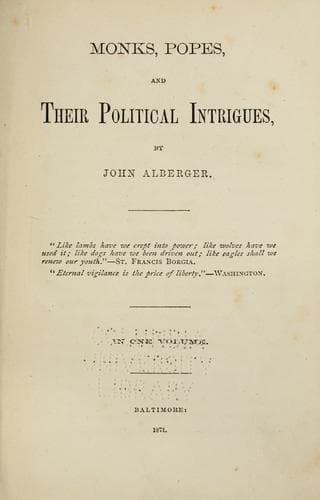
Monks, Popes, and their Political IntriguesAlberger, John
History
Monks, Popes, and their Political Intrigues
Alberger, John
Catholic Church; Catholic Church -- United States; Church and state
confederated forces were defeated, and the Protestants lost all that
they had acquired since the peace of Augsburg. At this dark hour in
the fortunes of the league, Gustavus Adolphus, with an army of thirty
thousand veterans, espoused its cause. His heroism, strategetic skill,
and indomitable valor soon annihilated Tilly's army, reduced the
imperial allies to extreme distress, conquered Lower Saxony and Bavaria,
and delivered the Protestants from their perilous situation. Tilly
having died, Wallenstein assumed command. Having raised an immense and
formidable army, the new general was enabled to attack Adolphus with
such overwhelming force that he compelled him to retire from Bavaria. In
1642, at Lutzen, the two powerful armies came to a general and decisive
engagement; the genius of Adolphus crowned his arms with victory, but
his intrepidity cost him his life. Through a wise policy the Swedes
still continued a triumphant career, victoriously marching through
the empire with incredible rapidity, and finally, after the battle of
Prague, dictating the peace of Westphalia.
By the terms of the peace of Westphalia Calvinists acquired the same
rights with Lutherans; princes were bound not to persecute subjects on
account of religious differences; all acquisitions of Protestants since
the peace of Augsburg were confirmed; entire equality of sect,
liberty of conscience, and the exercise of all modes of religion were
guaranteed, and the independence of Switzerland and of the Netherlands
acknowledged.
Pope Innocent X. strenuously protested against this peace, complaining
in bitter terms of the deep injury it inflicted on the church. Though
the consequences of the treaty have been of the most benignant nature
to Europe, still the Papal See has, through all periods maintained, with
unabated animosity, its original opposition to the invaluable treaty.
The papal intrigues, so prolific of disastrous wars, were no less
pernicious to Austria than they had been to other powers. Upon the death
of Duke Frederic, its ruler, Frederic II., of Germany, declared the
duchy a vacant fief of his empire, and appointed over it a governor.
Pope Innocent V. persuaded Margaret, the sister of the deceased duke,
and Gertrude, his neice, to claim the duchy as their inheritance. The
Margrave Hermann, by the aid of the pope and his machinery, was enabled
to command a strong party in support of the project. After a war of
thirty-six years the dispute was settled by the interference of the
emperor Rodolph, who gave it to his two sons, Albert and Ro-dolph.
Public-domain text, read in full here on John Shaqi.
Reviews
Reviews
No reviews yet
Be the first to share your thoughts on this work.
Elsewhere in the archive
Join the Discussion
Join the discussion
Sign in to leave a comment or review.
Sign InorCreate an account