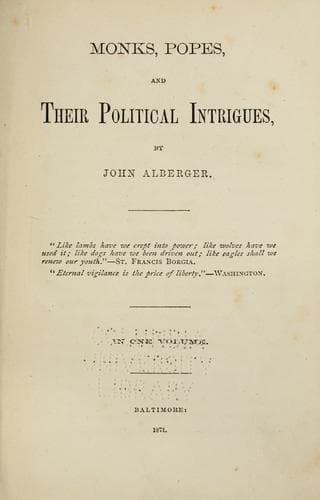
Monks, Popes, and their Political IntriguesAlberger, John
History
Monks, Popes, and their Political Intrigues
Alberger, John
Catholic Church; Catholic Church -- United States; Church and state
The papal intrigues with regard to the Netherlands, were fruitful of
sanguinary and deplorable consequences. Under the reign of Charles
V. one hundred thousand Protestants fell a sacrifice to the papal
intolerance. Philip, his son and successor, narrow in his views,
irritable in his temper, and implacable in his hate, transcended
even Charles in the inhumanity of his measures towards his Protestant
subjects. Cardinal Granvella having introduced into the Netherlands the
inquisition, for the extirpation of religious freedom, the Prince of
Orange, in conjunction with other distinguished personages, remonstrated
against the measure. This remonstrance was regarded by the government
as an act of treason. The haughtiness of the cardinal, and the severe
measures he introduced to intimidate the people, produced great disorder
and alarm. The nobles conspired to defend their rights; the Protestants
boldly celebrated their religious ceremonies, and the people fled
in crowds to England and Saxony. In spite of intolerant edicts and
excruciating torture, a bold spirit of resistance was excited in the
provinces. Philip recalled Cardinal Granvella, but appointed in his
place Alva, a more cruel and implacable tyrant. Proud, fierce and
imperious, this man knew of nothing but to command in a despotic tone,
and expect his subjects to tremble and obey. Sixty years of warfare
always successful, had familiarized him to deeds of blood, without
humbling him by the salutary lessons of misfortune. Death, the usual
penalty of disobedience to his commands, gave his mandate a terrific
importance. As soon as he had assumed the direction of the Netherland
provinces, he established a council of blood by means of, which he
condemned all whom he suspected of heresy, or whose fortunes excited a
prospect of increasing his own, The noblest of the nation fell under the
axe of his executioner; and as avarice had always been a prominent
trait of his character, he now illustrated the obduracy with which it is
capable of debasing humanity, by confiscating the property, not only of
the present but of the absent; not only of the living but of the dead.
Having cited the Prince of Orange to appear before his council, and that
prince having refused on the ground of his exemption by privilege, law
and usage, he declared him dispossessed of all property, and seizing
on his son, sent him to Spain as a hostage. The prince, heretofore a
liberal-minded Catholic, now declared himself a Protestant, and drew
his sword in favor of religious freedom. By a perseverance which no
difficulties could prostrate, a sagacity which no subterfuge could
deceive, a heroism which no danger could appall, and a magnanimity
which commanded the admiration of the world, he struggled through
discouragement, vexation and defeat until he had laid a solid foundation
for the freedom of the provinces, by reconstructing them in a judicious
confederacy, under the name of the United Provinces of the Netherlands,
Public-domain text, read in full here on John Shaqi.
Reviews
Reviews
No reviews yet
Be the first to share your thoughts on this work.
Elsewhere in the archive
Join the Discussion
Join the discussion
Sign in to leave a comment or review.
Sign InorCreate an account