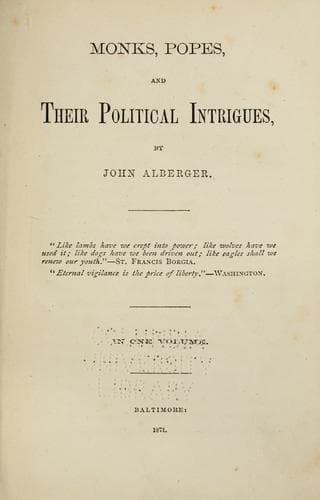
Monks, Popes, and their Political IntriguesAlberger, John
History
Monks, Popes, and their Political Intrigues
Alberger, John
Catholic Church; Catholic Church -- United States; Church and state
and inducing them to renounce allegiance to Spain. Philip hence declared
the prince an outlaw, and offered a reward of two hundred and fifty
thousand dollars for either his apprehension or his assassination. In
1584 the noble prince was shot dead by Balthazar Gerard, who confessed
that he had been instigated to the deed by a Franciscan monk and a
Jesuist priest. But though the founder of the republic fell a victim to
Romish treachery, its defence was continued with insuperable skill and
valor. Army after army sent against the republic was annihilated by the
indomitable bravery of its troops, until its soil became the cemetery
of the military strength of Spain. Its tolerance gave it population; its
freedom, energy; its maritime contests, a knowledge of navigation; and
its enterprise, commerce trade and prosperity. After a war of thirty
years, replete with heroism and magnanimity, it wrung from Spain, in the
Westphalia treaty, a full recognition of independence.
CHAPTER XV. PAPAL POLITICAL INTRIGUES IN PORTUGAL AND SPAIN.
In Portugal, under the reign of Alphonso I--Sancho II--
Dionysus--John II--Emanuel--John III--Sebastian--Philip II--
Joseph I--Maria Francesca Isabella--John VI--Pedro VI--and
Dona Maria.
In Spain, under the reign of Reccarred I--Charles V--Philip II--Philip
III--Charles II--Charles III. Charles IV.--and Ferdinand VII
Alphonso, in 1139, in the cause of the church and of national
independence, subjugated the Moors of Portugal. The victor was saluted
on the field by his army as king of the conquered dominion; the Cortes
Lamego invested him with regal authority; and Pope Alexander III.
acknowledged his legitimacy, the independence of the nation, and the
laws and constitution which were prescribed. By a provision of the
constitution, which probably sprung from the religious tolerance of the
Moorish regime, the king was prohibited under forfeiture of the crown,
from becoming tributary to any foreign power. But notwithstanding this
proud interdiction, Alphonso in the course of severe conflicts which
afterwards took place between him and the kings of Castile and Leon,
made his kingdom, in violation of his own constitution, a fief of Rome,
in order to secure the papal support.
In consequence of this concession to papal supremacy, Sancho II., in
1245, became involved in a dispute with the clergy; and upon appealing
to Pope Innocent IV., had the misfortune to lose his crown.
Public-domain text, read in full here on John Shaqi.
Reviews
Reviews
No reviews yet
Be the first to share your thoughts on this work.
Elsewhere in the archive
Join the Discussion
Join the discussion
Sign in to leave a comment or review.
Sign InorCreate an account