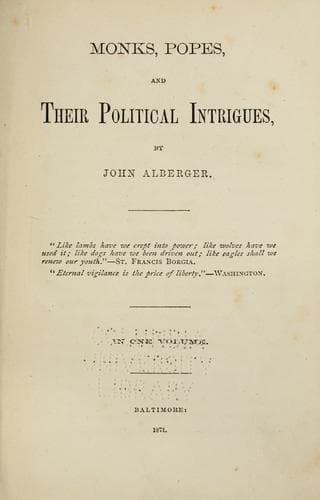
Monks, Popes, and their Political IntriguesAlberger, John
History
Monks, Popes, and their Political Intrigues
Alberger, John
Catholic Church; Catholic Church -- United States; Church and state
The capacity of the nation for greatness, notwithstanding the
degradation into which she had sunk, still animated the patriotic
Portuguese with the hopes of a national redemption. In 1640 a powerful
conspiracy was formed against the Spanish regime, and in 1750 the
political independence of Portugal was achieved, and Joseph I. elevated
to the throne. Duke Pombal, an able statesman, and the prime minister of
the government, regarding the Jesuists as the origin of the weakness
and disgraces of the government, and believing that their secrecy,
dissimulation and treachery, absolved him from any obligation he might
assume with regard to them, inconsistent with the public good, became a
member of their order that he might acquire a correct knowledge of their
principles and mode of operation, and be qualified to counteract their
pernicious machinations. With profound dissimulation, he so completely
deceived them that they admitted him to an intimate knowledge of all
their secrets, plans and designs. After having fully obtained his object
he made a public exposition of their secrets. He disclosed the dangerous
principles of their constitution, their political objects, the oaths
by which they were bound, the baseness of their intrigues, their false
professions, their horrible deeds, and their disgraceful rapacity and
profligacy. By the exposure which he was enabled to make he succeeded
in having them removed from the important position of confessors to the
king, and instructors of youth in colleges. He also induced Joseph to
expel them from the missions of Paraguay; to abridge the power of the
bishops; and to prohibit the celebration of the "auto-da-fe" of the
inquisition. The Jesuists not being able successfully to arrest the
progress of reform determined to assassinate the king; but failing in
this attempt, the whole order fell under the ban of the kingdom, and
were officially declared a political organization under the mask of
religion, and its members expelled from the kingdom as enemies of
the public peace, and traitors to the government. Pope Clement XIII.,
enraged at this summary destruction of the most efficient department
of his machinery, endeavored to intimidate the reformers by threats of
excommunication, and commissioned a legate to adopt any means to arrest
proceedings against the Jesuists. But his legate was promptly escorted
out of the kingdom; and as the conduct of the holy father in protecting
and defending an organization of traitors and assassins, implicated him
in the guilt of an accessory, all connection with the See of Rome
was declared dissolved until the imputation should be removed by the
abolishment of the Jesuistical order. The vanity of Pope Clement
could not permit him to suffer such a mortification, and the decree of
dissolution was rigorously enforced; but his successor, at the hazard
of disproving the papal infallibility, complying with the demands of
Portugal, amicable relations were re-established.
Public-domain text, read in full here on John Shaqi.
Reviews
Reviews
No reviews yet
Be the first to share your thoughts on this work.
Elsewhere in the archive
Join the Discussion
Join the discussion
Sign in to leave a comment or review.
Sign InorCreate an account