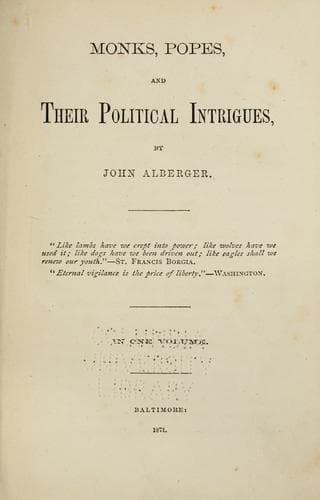
Monks, Popes, and their Political IntriguesAlberger, John
History
Monks, Popes, and their Political Intrigues
Alberger, John
Catholic Church; Catholic Church -- United States; Church and state
On the death of Joseph I., in 1777, Maria Francesca Isabella, his eldest
daughter, succeeded to the royal dignity. The superstitious temperament
of this queen, and her natural infirmity, which terminated in confirmed
mental alienation, disqualified her for the administration of
the governmental powers on sound principles of public policy, and
surrendered her to the selfish control of a corrupt priesthood and
ambitious nobility. By the intrigues of these two classes, which seldom
scruple to sacrifice the popular interest to their personal advantage,
Pombal was deprived of his useful political influence, most of his
regulations were abolished, and Portugal, from the dawn of a magnificent
future, sunk into the obscurity and lethargy of her former condition.
In 1817 John VI., who had been regent during the imbecility of the
queen, from 1795 to her death, ascended the throne. The spirit of French
republicanism exerted a liberalizing influence over Europe generally,
and had apparently a similar effect on the pope and his machinery.
Those who did not understand the profoundity of sacerdotal craft might
have been stupefied with astonishment to see a pope, while professing
to be infallible, discarding principles and policies which had
been approved by the practice, and defended by the anathemas of his
predecessors. He not only sanctioned the prohibition of Portugal
forbidding Jesuists from entering the kingdom, and consented to the
abolition of the inquisition, but even requested that all persecution
against the Jews should cease, and that they should be admitted to
greater rights and privileges. The popular current had set in too
strongly in favor of change in the constitution and administration of
the government for papal sagacity to oppose, and unobstructed by
the sacerdotal machinery, it became daily augmented in volume and
impetuosity. The liberal feeling of the nation, allowed spontaneously to
flow, culminated in 1820 in establishing, without violence or bloodshed,
a provisional government and a new cortes. Tolerance on the lips of a
Catholic priest is treason to Rome; and, though this circumstance might
have cautioned prudence against investing any of them with power, yet
as they had warmly espoused the liberal cause, they were elected by the
people as members to the cortes, with the exception of a few lawyers
and governmental officers. At the assemblage of the cortes, under the
presidency of the archbishop of Braga, the revolutionary measures were
sanctioned, the inquisition forever interdicted, and a constitution
framed which secured freedom of person and property, the liberty of
the press, and legal equality. The king approved the provisions of
this constitution, and swore to support it. But under this prosperous
appearance of republican progress, the demon of religious intolerance
was secretly at work; availing itself of every means to arrest the
popular current. The portentous mutterings of an approaching storm were
Public-domain text, read in full here on John Shaqi.
Reviews
Reviews
No reviews yet
Be the first to share your thoughts on this work.
Elsewhere in the archive
Join the Discussion
Join the discussion
Sign in to leave a comment or review.
Sign InorCreate an account