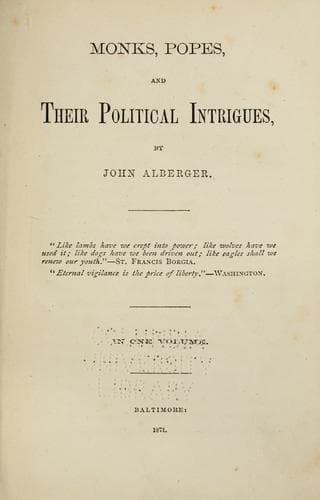
Monks, Popes, and their Political IntriguesAlberger, John
History
Monks, Popes, and their Political Intrigues
Alberger, John
Catholic Church; Catholic Church -- United States; Church and state
But it will be said that Protestants have been guilty of persecution as
well as Catholics. This assertion is unquestionably true. We confess,
with regret, that Protestantism, although she admits the right of
private judgment, has proved a foe to civil and religious liberty, But
unlike Catholicism, she has made concessions; reluctantly, indeed,
but still she has made them. Guizot confesses that her practice has
necessarily been inconsistent with her profession of toleration. She,
however, claims not, like Catholicism, to be the source and supreme
controller of all political power; nor to be the sole disposer of crowns
and kingdoms; nor has she elaborated a policy, adopted a systematic
course of measures, and organized a clerical force for the acquisition
of supreme and universal temporal and spiritual dominion. She has no
central head, with spies penetrating all domestic and national secrets,
and communicating to it the information they have acquired. She has no
political-machinery ramifying every part of Christendom, and acting in
concert for the promotion of her interests. She has no convents,
nor nunneries; nor monastic vows; no father confessors; no religious
confessional; no religious orders, no military knights; and no spiritual
guides. She imposes no oaths of allegiance on her priests, requiring
them to adopt every available method of subjugating all government
under her authority. She has no inquisition, no rack and torture for
her opponents; no pretensions to absolve subjects from their oaths of
allegiance; no interdicts to alarm superstitious minds by the suspension
of religious worship in disaffected kingdoms. She has never interfered
between rulers and their subjects, concocting treason, fomenting
sedition, and producing anarchy. She has never organized armies for the
extension of her dominion, and for the subjugation of kingdoms to her
authority. She has never butchered whole cities for unbelief, nor in
one day put one hundred thousand heretics to death. She has done none of
these things, yet her hands are not unstained with innocent blood. Would
they were. Henry VIII., of England, persecuted with equal severity
those who believed in the pope's right to temporal power, and those
who disbelieved the other dogmas of Catholicism. The Church of England,
under Charles I., inflicted the most atrocious punishment on the Irish
Catholics; under James I., on the Puritans; and under Elizabeth, it
oppressed both Catholics and dissenters with tyrannical measures, and
illiberal disabilities. The Puritan Cromwell persecuted both Catholics
and Episcopalians. In Ireland he wasted the Catholics with fire and
sword; in Scotland he put whole garrisons of dissenters to death; and
as his schemes for obtaining the royal dignity suggested, persecuted
Covenanters, Republicans, and Puritans. When Charles II. was elevated to
the throne he deprived 2000 dissenting clergymen of their livings; and
Public-domain text, read in full here on John Shaqi.
Reviews
Reviews
No reviews yet
Be the first to share your thoughts on this work.
Elsewhere in the archive
Join the Discussion
Join the discussion
Sign in to leave a comment or review.
Sign InorCreate an account