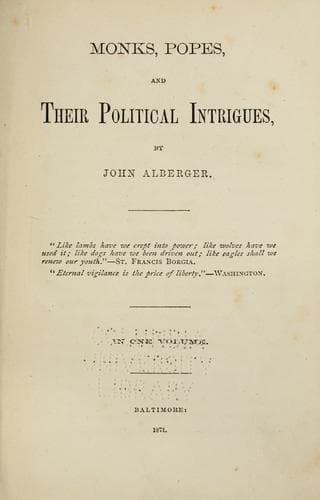
Monks, Popes, and their Political IntriguesAlberger, John
History
Monks, Popes, and their Political Intrigues
Alberger, John
Catholic Church; Catholic Church -- United States; Church and state
by his five-mile act prohibited them from approaching within five miles
of their former parishes. But the rigor of Protestantism eventually
relaxed its severity. Under William III. some of the disabilities which
oppressed the dissenters were removed; and under that of George III.
additional toleration was accorded. Still it must be admitted that the
ablest agents in extorting these concessions to religious liberty
were the Free Thinkers of that age. Yet the Quakers, always the most
respectable body of citizens, and the professors of the most harmless of
all creeds, were still punished with fines, confiscation, imprisonment
and death. All who disbelieved in the holy trinity were also subject
to similar persecutions. Not until 1813 did Protestant England cease
to punish a belief in Unitarianism with imprisonment, and legal
disabilities. John Calvin, at the head of the Consistory of Geneva, had
John Guet beheaded on a charge of attempting to overthrow the doctrines
of the Calvinistic church; and Micheal Servetus arrested and burnt alive
for having attacked the doctrine of the holy trinity. Even in republic
America, under the elevating influence of liberal institutions, the
intolerant spirit of religious bigotry predominates more or less over
the mind of the Christian republic. In Massachusetts Baptists and
Quakers were once fined, imprisoned, and burnt alive. In Virginia all
Quakers that disbelieved in the holy trinity, and all persons that
refused to have their children baptized were scourged, confined,
banished or put to death. In Pennsylvania, under the charter of William
Penn, all Atheists were excluded from official position. In Maryland
disbelief in the holy trinity was declared to be a capital offence;
and not until recently was any person, who professed not to believe in
Christianity, unless a Jew, eligible to any office of trust or profit in
the State; nor even to this day is any person eligible who disbelieves
in a God. The statute books of every Protestant country bear testimony
to the same illiberality. Humboldt, Cuviert Buffon, La Place, Gibbon,
Voltaire, Hume, Jefferson, and other eminent scholars and patriots
would, by the provisions of almost every State constitution in the
Union, be debarred from filling the lowest office that they create. In
fact the history of no religious sectary indicates it to be a bond of
love, union, or concord. Every Protestant creed, sectary or conclave,
is a perpetual source of mutual jealousy, animosity and persecution,
The same intolerant spirit breathes its malignancy over the pages of the
religious press. "If we are not Christians," says the _Church Union_,
"let us make no hypocritical pretensions of founding governments on
Christian principles. If we are, I believe that they should predominate
over our whole life; let us have them incorporated in the basis of our
government, and the national policy shaped by them. Let no one hold an
office of trust or profit whose life is not conformably thereto."
Public-domain text, read in full here on John Shaqi.
Reviews
Reviews
No reviews yet
Be the first to share your thoughts on this work.
Elsewhere in the archive
Join the Discussion
Join the discussion
Sign in to leave a comment or review.
Sign InorCreate an account