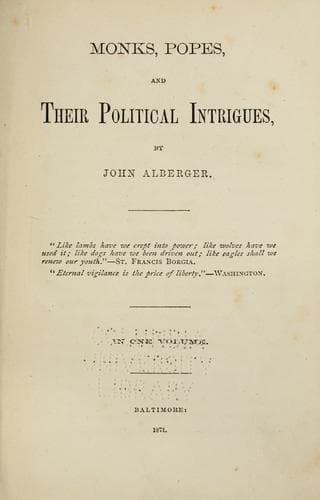
Monks, Popes, and their Political IntriguesAlberger, John
History
Monks, Popes, and their Political Intrigues
Alberger, John
Catholic Church; Catholic Church -- United States; Church and state
Had Constantine the Great, though
frenzied with ambition and crimsoned with guilt, beheld the boundless
ocean of gore which was destined to flow from an incorporation of
Christianity with the civil power, and to roll its heavy surge over all
future time, he would have been more obdurate than a fiend had he not
cowled his head in horror at the frightful vision, and dropped in mercy
the pen already inked to inaugurate the tremendous catastrophe. Yet
how sickening is the thought that the example of this ambitious tyrant,
loaded with the curses of ages, is now attempted to be imitated by
Protestant priests, political judges, and United States officials. But
thanks to nature, the play of the natural principles of liberty in the
minds of some priests, have been too strong to be repressed by dogmatic
creeds. Gloriously inconsistent with their principles, they have
inscribed their names in imperishable honor on the scroll of liberty.
Thankful for the few names blazoned there, freedom must drop a tear over
the smallness of the number.
It will be asked, perhaps, notwithstanding the facts which have been
adduced showing the political nature and designs of the Catholic church,
what has the American republic to apprehend from it? It will be asked,
Did not Catholics fight for the establishment of a free government in
the revolutionary war? Did they not fight to defend it in the war of
1812? Did they not fight to preserve its unity in the late rebellion? No
well informed person will answer these questions in the negative; and
no candid person will fail to acknowledge the distinguished valor and
liberality which they displayed on these occasions. Catholics are
men; and the love of liberty is a natural principle of the human
constitution. Ignorance may blind it; prejudice mislead it; and
superstition overawe it; but when the natural vigor of its disposition
is aroused it will assert its rights in defiance of creeds, shackles and
stakes. It is not the nature, but the education of Catholics, and the
religious despotism with which they are enthralled, that has so often
deprived freedom of their homage and allegiance. The frequent opposition
of Catholic princes to the policy and measures of the popes, the
numerous leagues which they have formed, and the vast armies which they
have raised in their support, abundantly show how often their reverence
for the pope has been displaced by defiance to his authority, and
contempt for his pretensions. The liberal minded people of France have,
from an early date, boldly opposed the pope's claim to temporal power.
St. Louis IX., in 1269, declared in a pragmatic sanction, that the
temporal power of France was independent of the jurisdiction of Rome.
Charles VIII., of France, in a pragmatic sanction issued in 1433,
asserted for France, in conformity with the canons of the Council of
Basle, independence of Rome in all temporal matters. Louis XIV., in 1682
convened a national council of the clergy at Paris, which decided that
Public-domain text, read in full here on John Shaqi.
Reviews
Reviews
No reviews yet
Be the first to share your thoughts on this work.
Elsewhere in the archive
Join the Discussion
Join the discussion
Sign in to leave a comment or review.
Sign InorCreate an account