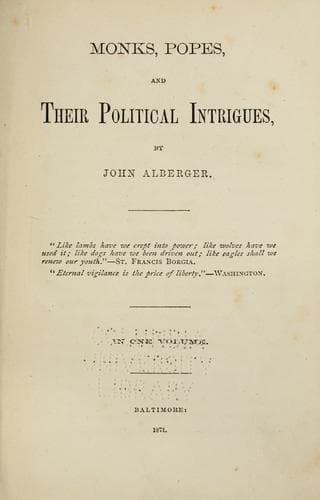
Monks, Popes, and their Political IntriguesAlberger, John
History
Monks, Popes, and their Political Intrigues
Alberger, John
Catholic Church; Catholic Church -- United States; Church and state
the Pope of Rome had no power to interfere, directly or indirectly, in
the temporal concerns of princes and sovereigns; that the usages of the
French church are inviolable; that the authority of the general councils
is superior to that of the pope; and that the pope is not infallible in
matters of faith. The popes, by the means of bulls, have attempted
to nullify these acts, but nevertheless they form the distinctive
principles of the Gallican Church, and also of other Catholic churches
in different; kingdoms of Europe. The Fenian order is another happy
instance of the predominance which patriotism may gain, in the minds of
Catholics, over their reverence for the church and its despotism.
If Catholics have at various times chastised the pope, deprived him of
temporal authority, assaulted his person, imprisoned and deposed him,
it is not surprising that they fought in the defence of the independence
and freedom of America, No one that has an adequate conception of the
papal policy, will be much astonished that the Catholics were prominent
leaders in the revolutionary war. It was a cause in which the pope
himself, in perfect consistency with his pretensions, might have
personally engaged. The pope claims England as his fief, and denounces
her kings as usurpers. The success of a revolt intended to deprive
England of her colonies was as gratifying to his revenge as it was
flattering to his ulterior designs on the colonies themselves. In a
republic he could plant his machinery, build up at will his monastic
penitentiaries, erect his strong castle-like and secret-celled churches,
leisurely select and occupy eligible and strategic points for citadels,
and collect from every kingdom his most faithful and reliable subjects.
Bishop Hughes asserted that Catholicism was friendly to republics, for
they allowed its free development. But the development of Catholicism
involves the subversion of republics, and the establishment in their
place of political and religious despotism.
Public-domain text, read in full here on John Shaqi.
Reviews
Reviews
No reviews yet
Be the first to share your thoughts on this work.
Elsewhere in the archive
Join the Discussion
Join the discussion
Sign in to leave a comment or review.
Sign InorCreate an account