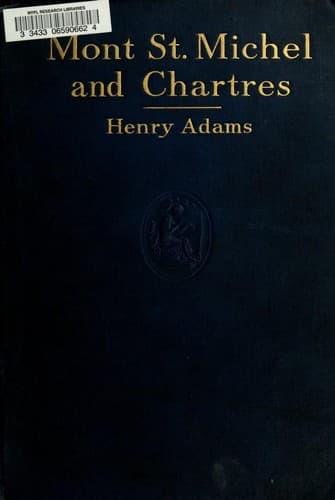
Cathédrale de Chartres; Civilization, Medieval; Mont-Saint-Michel (Abbey : France)
Three times, in these short extracts, the word "courteous" has
already appeared. The story itself is promised as "courteous";
Nicolette is "courteous"; and the ladies who are not to go to heaven
are "courteous." Aucassins is in the full tide of courtesy, and
evidently a professional, or he never would have claimed a place for
harpers and jongleurs with kings and chevaliers in the next world.
The poets of "courteous love" showed as little interest in religion
as the poets of the eleventh century had shown for it in their poems
of war. Aucassins resembled Christian of Troyes in this, and both of
them resembled Thibaut, while William of Lorris went beyond them
all. The literature of the "siecle" was always unreligious, from the
"Chanson de Roland" to the "Tragedy of Hamlet"; to be "papelard" was
unworthy of a chevalier; the true knight of courtesy made nothing of
defying the torments of hell, as he defied the lance of a rival, the
frowns of society, the threats of parents or the terrors of magic;
the perfect, gentle, courteous lover thought of nothing but his
love. Whether the object of his love were Nicolette of Beaucaire or
Blanche of Castile, Mary of Champagne or Mary of Chartres, was a
detail which did not affect the devotion of his worship.
So Nicolette, shut up in a vaulted chamber, leaned out at the marble
window and sang, while Aucassins, when his father promised that he
should have a kiss from Nicolette, went out to make fabulous
slaughter of the enemy; and when his father broke the promise, shut
himself up in his chamber, and also sang; and the action went on by
scenes and interludes, until, one night, Nicolette let herself down
from the window, by the help of sheets and towels, into the garden,
and, with a natural dislike of wetting her skirts which has
delighted every hearer or reader from that day to this, "prist se
vesture a l'une main devant et a l'autre deriere si s'escorca por le
rousee qu'ele vit grande sor l'erbe si s'en ala aval le gardin"; she
raised her skirts with one hand in front and the other behind, for
the dew which she saw heavy on the grass, and went off down the
garden, to the tower where Aucassins was locked up, and sang to him
through a crack in the masonry, and gave him a lock of her hair, and
they talked till the friendly night-watch came by and warned her by
a sweetly-sung chant, that she had better escape. So she bade
farewell to Aucassins, and went on to a breach in the city wall, and
she looked through it down into the fosse which was very deep and
very steep. So she sang to herself--
Peres rois de maeste
Or ne sai quel part aler.
Se je vois u gaut rame
Ja me mengeront li le
Li lions et li sengler
Dont il i a a plente.
Father, King of Majesty!
Now I know not where to flee.
If I seek the forest free,
Then the lions will eat me,
Wolves and wild boars terribly,
Of which plenty there there be.
Public-domain text, read in full here on John Shaqi.
Reviews
Reviews
No reviews yet
Be the first to share your thoughts on this work.
Elsewhere in the archive
Join the Discussion
Join the discussion
Sign in to leave a comment or review.
Sign InorCreate an account