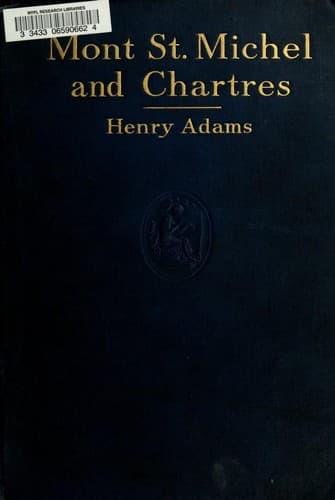
Cathédrale de Chartres; Civilization, Medieval; Mont-Saint-Michel (Abbey : France)
The lions were a touch of poetic licence, even for Beaucaire, but
the wolves and wild boars were real enough; yet Nicolette feared
even them less than she feared the Count, so she slid down what her
audience well knew to be a most dangerous and difficult descent, and
reached the bottom with many wounds in her hands and feet, "et san
en sali bien en xii lius"; so that blood was drawn in a dozen
places, and then she climbed up the other side, and went off bravely
into the depths of the forest; an uncanny thing to do by night, as
you can still see.
Then followed a pastoral, which might be taken from the works of
another poet of the same period, whose acquaintance no one can
neglect to make--Adam de la Halle, a Picard, of Arras. Adam lived,
it is true, fifty years later than the date imagined for Aucassins,
but his shepherds and shepherdesses are not so much like, as
identical with, those of the Southern poet, and all have so singular
an air of life that the conventional courteous knight fades out
beside them. The poet, whether bourgeois, professional, noble, or
clerical, never much loved the peasant, and the peasant never much
loved him, or any one else. The peasant was a class by himself, and
his trait, as a class, was suspicion of everybody and all things,
whether material, social, or divine. Naturally he detested his lord,
whether temporal or spiritual, because the seigneur and the priest
took his earnings, but he was never servile, though a serf; he was
far from civil; he was commonly gross. He was cruel, but not more so
than his betters; and his morals were no worse. The object of
oppression on all sides,--the invariable victim, whoever else might
escape,--the French peasant, as a class, held his own--and more. In
fact, he succeeded in plundering Church, Crown, nobility, and
bourgeoisie, and was the only class in French history that rose
steadily in power and well-being, from the time of the crusades to
the present day, whatever his occasional suffering may have been;
and, in the thirteenth century, he was suffering. When Nicolette, on
the morning after her escape, came upon a group of peasants in the
forest, tending the Count's cattle, she had reason to be afraid of
them, but instead they were afraid of her. They thought at first
that she was a fairy. When they guessed the riddle, they kept the
secret, though they risked punishment and lost the chance of reward
by protecting her. Worse than this, they agreed, for a small
present, to give a message to Aucassins if he should ride that way.
Aucassins was not very bright, but when he got out of prison after
Nicolette's escape, he did ride out, at his friends' suggestion, and
tried to learn what had become of her. Passing through the woods he
came upon the same group of shepherds and shepherdesses:--
Esmeres et Martinet, Fruelins et Johannes, Robecons et
Aubries,--
Public-domain text, read in full here on John Shaqi.
Reviews
Reviews
No reviews yet
Be the first to share your thoughts on this work.
Elsewhere in the archive
Join the Discussion
Join the discussion
Sign in to leave a comment or review.
Sign InorCreate an account