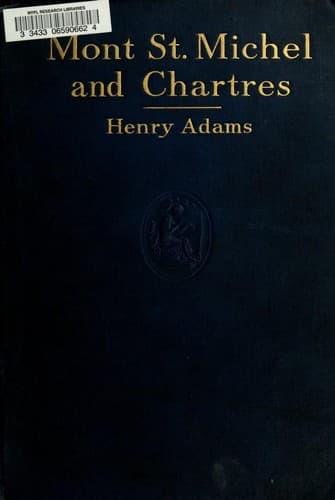
Cathédrale de Chartres; Civilization, Medieval; Mont-Saint-Michel (Abbey : France)
But apart from this, the deepest value of Mont-Saint-Michel and
Chartres, its importance as a revelation of the eternal glory of
mediaeval art and the elements that brought it into being is not
lightly to be expressed. To every artist, whatever his chosen form
of expression, it must appear unique and invaluable, and to none
more than the architect, who, familiar at last with its beauties,
its power, and its teaching force, can only applaud the action of
the American Institute of Architects in making Mr. Adams an Honorary
Member, as one who has rendered distinguished services to the art,
and voice his gratitude that it has brought the book within his
reach and given it publicity before the world.
Whitehall, Sudbury, Massachusetts, June, 1913.
CONTENTS
PREFACE
I. SAINT MICHIEL DE LA MER DEL PERIL
II. LA CHANSON DE ROLAND
III. THE MERVEILLE
IV. NORMANDY AND THE ILE DE FRANCE
V. TOWERS AND PORTALS
VI. THE VIRGIN OF CHARTRES
VII. ROSES AND APSES
VIII. THE TWELFTH-CENTURY GLASS
IX. THE LEGENDARY WINDOWS
X. THE COURT OF THE QUEEN OF HEAVEN
XI. THE THREE QUEENS
XII. NICOLETTE AND MARION
XIII. LES MIRACLES DE NOTRE DAME
XIV. ABELARD
XV. THE MYSTICS
XVI. SAINT THOMAS AQUINAS
Preface
[December, 1904.]
Some old Elizabethan play or poem contains the lines:--
. . . Who reads me, when I am ashes,
Is my son in wishes . . . . . . . . .
The relationship, between reader and writer, of son and father, may
have existed in Queen Elizabeth's time, but is much too close to be
true for ours. The utmost that any writer could hope of his readers
now is that they should consent to regard themselves as nephews, and
even then he would expect only a more or less civil refusal from
most of them. Indeed, if he had reached a certain age, he would have
observed that nephews, as a social class, no longer read at all, and
that there is only one familiar instance recorded of a nephew who
read his uncle. The exception tends rather to support the rule,
since it needed a Macaulay to produce, and two volumes to record it.
Finally, the metre does not permit it. One may not say: "Who reads
me, when I am ashes, is my nephew in wishes."
The same objections do not apply to the word "niece." The change
restores the verse, and, to a very great degree, the fact. Nieces
have been known to read in early youth, and in some cases may have
read their uncles. The relationship, too, is convenient and easy,
capable of being anything or nothing, at the will of either party,
like a Mohammedan or Polynesian or American marriage. No valid
objection can be offered to this choice in the verse. Niece let it
be!
Public-domain text, read in full here on John Shaqi.
Reviews
Reviews
No reviews yet
Be the first to share your thoughts on this work.
Join the Discussion
Join the discussion
Sign in to leave a comment or review.
Sign InorCreate an account