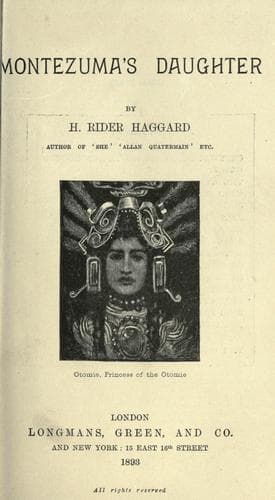
Montezuma's DaughterHaggard, H. Rider (Henry Rider)
History
Montezuma's Daughter
Haggard, H. Rider (Henry Rider)
Mexico -- History -- Conquest, 1519-1540 -- Fiction
Now to shorten a long tale, the end of the matter was this. It was
believed both by my grandfather and the prior that the true cause of my
father’s contumacy was a passion which he had conceived for a girl of
humble birth, a miller’s fair daughter who dwelt at Waingford Mills.
Perhaps there was truth in this belief, or perhaps there was none. What
does it matter, seeing that the maid married a butcher at Beccles and
died years since at the good age of ninety and five? But true or false,
my grandfather believed the tale, and knowing well that absence is the
surest cure for love, he entered into a plan with the prior that my
father should be sent to a monastery at Seville in Spain, of which the
prior’s brother was abbot, and there learn to forget the miller’s
daughter and all other worldly things.
When this was told to my father he fell into it readily enough, being a
young man of spirit and having a great desire to see the world,
otherwise, however, than through the gratings of a monastery window. So
the end of it was that he went to foreign parts in the care of a party
of Spanish monks, who had journeyed here to Norfolk on a pilgrimage to
the shrine of our Lady of Walsingham.
It is said that my grandfather wept when he parted with his son,
feeling that he should see him no more; yet so strong was his religion,
or rather his superstition, that he did not hesitate to send him away,
though for no reason save that he would mortify his own love and flesh,
offering his son for a sacrifice as Abraham would have offered Isaac.
But though my father appeared to consent to the sacrifice, as did
Isaac, yet his mind was not altogether set on altars and faggots; in
short, as he himself told me in after years, his plans were already
laid.
Thus it chanced that when he had sailed from Yarmouth a year and six
months, there came a letter from the abbot of the monastery in Seville
to his brother, the prior of St. Mary’s at Bungay, saying that my
father had fled from the monastery, leaving no trace of where he had
gone. My grandfather was grieved at this tidings, but said little about
it.
Two more years passed away, and there came other news, namely, that my
father had been captured, that he had been handed over to the power of
the Holy Office, as the accursed Inquisition was then named, and
tortured to death at Seville. When my grandfather heard this he wept,
and bemoaned himself that his folly in forcing one into the Church who
had no liking for that path, had brought about the shameful end of his
only son. After that date also he broke his friendship with the prior
of St. Mary’s at Bungay, and ceased his offerings to the priory. Still
he did not believe that my father was dead in truth, since on the last
day of his own life, that ended two years later, he spoke of him as a
living man, and left messages to him as to the management of the lands
which now were his.
Public-domain text, read in full here on John Shaqi.
Reviews
Reviews
No reviews yet
Be the first to share your thoughts on this work.
Join the Discussion
Join the discussion
Sign in to leave a comment or review.
Sign InorCreate an account