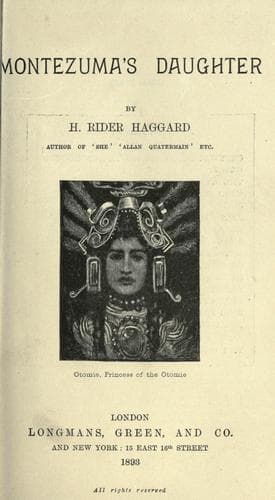
Montezuma's DaughterHaggard, H. Rider (Henry Rider)
History
Montezuma's Daughter
Haggard, H. Rider (Henry Rider)
Mexico -- History -- Conquest, 1519-1540 -- Fiction
I went down to the breach in the roadway and spoke with their envoy,
who stood upon the path below. At first the terms offered were that we
should surrender at discretion. To this I answered that sooner than do
so we would die where we were. Their reply was that if we would give
over all who had any part in the human sacrifice, the rest of us might
go free. To this I said that the sacrifice had been carried out by
women and some few men, and that all of these were dead by their own
hands. They asked if Otomie was also dead. I told them no, but that I
would never surrender unless they swore that neither she nor her son
should be harmed, but rather that together with myself they should be
given a safe-conduct to go whither we willed. This was refused, but in
the end I won the day, and a parchment was thrown up to me on the point
of a lance. This parchment, which was signed by the Captain Bernal
Diaz, set out that in consideration of the part that I and some men of
the Otomie had played in rescuing the Spanish captives from death by
sacrifice, a pardon was granted to me, my wife and child, and all upon
the _teocalli_, with liberty to go whither-soever we would unharmed,
our lands and wealth being however declared forfeit to the viceroy.
With these terms I was well content, indeed I had never hoped to win
any that would leave us our lives and liberty.
And yet for my part death had been almost as welcome, for now Otomie
had built a wall between us that I could never climb, and I was bound
to her, to a woman who, willingly or no, had stained her hands with
sacrifice. Well, my son was left to me and with him I must be
satisfied; at the least he knew nothing of his mother’s shame. Oh! I
thought to myself as I climbed the _teocalli_, oh! that I could but
escape far from this accursed land and bear him with me to the English
shores, ay, and Otomie also, for there she might forget that once she
had been a savage. Alas! it could scarcely be!
Coming to the temple, I and those with me told the good tidings to our
companions, who received it silently. Men of a white race would have
rejoiced thus to escape, for when death is near all other loss seems as
nothing. But with these Indian people it is not so, since when fortune
frowns upon them they do not cling to life. These men of the Otomie had
lost their country, their wives, their wealth, their brethren, and
their homes; therefore life, with freedom to wander whither they would,
seemed no great thing to them. So they met the boon that I had won from
the mercy of our foes, as had matters gone otherwise they would have
met the bane, in sullen silence.
I came to Otomie, and to her also I told the news.
“I had hoped to die here where I am,” she answered. “But so be it;
death is always to be found.”
Only my son rejoiced, because he knew that God had saved us all from
death by sword or hunger.
Public-domain text, read in full here on John Shaqi.
Reviews
Reviews
No reviews yet
Be the first to share your thoughts on this work.
Elsewhere in the archive
Join the Discussion
Join the discussion
Sign in to leave a comment or review.
Sign InorCreate an account