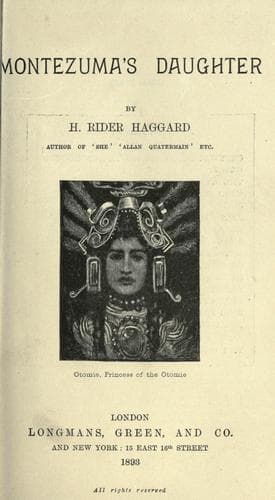
Montezuma's DaughterHaggard, H. Rider (Henry Rider)
History
Montezuma's Daughter
Haggard, H. Rider (Henry Rider)
Mexico -- History -- Conquest, 1519-1540 -- Fiction
“Father,” he said, “the Spaniards have given us life, but they take our
country and drive us out of it. Where then shall we go?”
“I do not know, my son,” I answered.
“Father,” the lad said again, “let us leave this land of Anahuac where
there is nothing but Spaniards and sorrow. Let us find a ship and sail
across the seas to England, our own country.”
The boy spoke my very thought and my heart leapt at his words, though I
had no plan to bring the matter about. I pondered a moment, looking at
Otomie.
“The thought is good, Teule,” she said, answering my unspoken question;
“for you and for our son there is no better, but for myself I will
answer in the proverb of my people, ‘The earth that bears us lies
lightest on our bones.’”
Then she turned, making ready to quit the storehouse of the temple
where we had been lodged during the siege, and no more was said about
the matter.
Before the sun set a weary throng of men, with some few women and
children, were marching across the courtyard that surrounded the
pyramid, for a bridge of timbers taken from the temple had been made
over the breach in the roadway that wound about its side.
At the gates the Spaniards were waiting to receive us. Some of them
cursed us, some mocked, but those of the nobler sort said nothing, for
they pitied our plight and respected us for the courage we had shown in
the last struggle. Their Indian allies were there also, and these
grinned like unfed pumas, snarling and whimpering for our lives, till
their masters kicked them to silence. The last act of the fall of
Anahuac was as the first had been, dog still ate dog, leaving the
goodly spoil to the lion who watched.
At the gates we were sorted out; the men of small condition, together
with the children, were taken from the ruined city by an escort and
turned loose upon the mountains, while those of note were brought to
the Spanish camp, to be questioned there before they were set free. I,
with my wife and son, was led to the palace, our old home, there to
learn the will of the Captain Diaz.
It is but a little way to go, and yet there was something to be seen in
the path. For as we walked I looked up, and before me, standing with
folded arms and apart from all men, was de Garcia. I had scarcely
thought of him for some days, so full had my mind been of other
matters, but at the sight of his evil face I remembered that while this
man lived, sorrow and danger must be my bedfellows.
He watched us pass, taking note of all, then he called to me who walked
last:
“Farewell, Cousin Wingfield. You have lived through this bout also and
won a free pardon, you, your woman and your brat together. If the old
war-horse who is set over us as a captain had listened to me you should
have been burned at the stake, every one of you, but so it is. Farewell
for a while, friend. I am away to Mexico to report these matters to the
viceroy, who may have a word to say.”
Public-domain text, read in full here on John Shaqi.
Reviews
Reviews
No reviews yet
Be the first to share your thoughts on this work.
Elsewhere in the archive
Join the Discussion
Join the discussion
Sign in to leave a comment or review.
Sign InorCreate an account