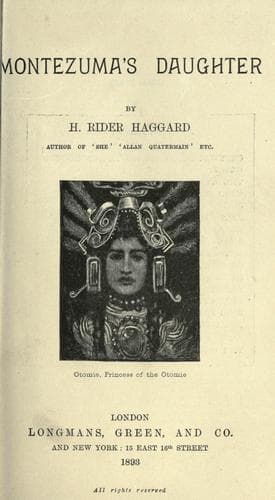
Montezuma's DaughterHaggard, H. Rider (Henry Rider)
History
Montezuma's Daughter
Haggard, H. Rider (Henry Rider)
Mexico -- History -- Conquest, 1519-1540 -- Fiction
I made no answer, but asked of our conductor, that same Spaniard whom I
had saved from the sacrifice, what the señor meant by his words.
“This, Teule; that there has been a quarrel between our comrade Sarceda
and our captain. The former would have granted you no terms, or failing
this would have decoyed you from your stronghold with false promises,
and then have put you to the sword as infidels with whom no oath is
binding. But the captain would not have it so, for he said that faith
must be kept even with the heathen, and we whom you had saved cried
shame on him. And so words ran high, and in the end the Señor Sarceda,
who is third in command among us, declared that he would be no party to
this peacemaking, but would be gone to Mexico with his servants, there
to report to the viceroy. Then the Captain Diaz bade him begone to hell
if he wished and report to the devil, saying that he had always
believed that he had escaped thence by mistake, and they parted in
wrath who, since the day of _noche triste_, never loved each other
much; the end of it being that Sarceda rides for Mexico within an hour,
to make what mischief he can at the viceroy’s court, and I think that
you are well rid of him.”
“Father,” said my son to me, “who is that Spaniard who looks so cruelly
upon us?”
“That is he of whom I have told you, son, de Garcia, who has been the
curse of our race for two generations, who betrayed your grandfather to
the Holy Office, and murdered your grandmother, who put me to torture,
and whose ill deeds are not done with yet. Beware of him, son, now and
ever, I beseech you.”
Now we were come to the palace, almost the only house that was left
standing in the City of Pines. Here an apartment was given to us at the
end of the long building, and presently a command was brought to us
that I and my wife should wait upon the Spanish captain Diaz.
So we went, though Otomie desired to stay behind, leaving our son alone
in the chamber where food had been brought to him. I remember that I
kissed him before I left, though I do not know what moved me to do so,
unless it was because I thought that he might be asleep when I
returned. The Captain Diaz had his quarters at the other end of the
palace, some two hundred paces away. Presently we stood before him. He
was a rough-looking, thick-set man well on in years, with bright eyes
and an ugly honest face, like the face of a peasant who has toiled a
lifetime in all weathers, only the fields that Diaz tilled were fields
of war, and his harvest had been the lives of men. Just then he was
joking with some common soldiers in a strain scarcely suited to nice
ears, but so soon as he saw us he ceased and came forward. I saluted
him after the Indian fashion by touching the earth with my hand, for
what was I but an Indian captive?
“Your sword,” he said briefly, as he scanned me with his quick eyes.
I unbuckled it from my side and handed it to him, saying in Spanish:
Public-domain text, read in full here on John Shaqi.
Reviews
Reviews
No reviews yet
Be the first to share your thoughts on this work.
Elsewhere in the archive
Join the Discussion
Join the discussion
Sign in to leave a comment or review.
Sign InorCreate an account