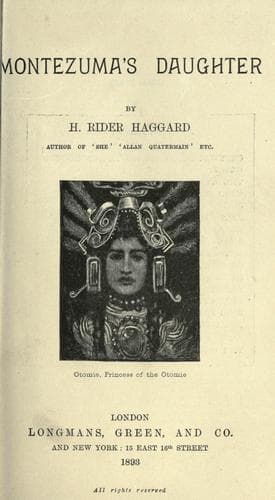
Montezuma's DaughterHaggard, H. Rider (Henry Rider)
History
Montezuma's Daughter
Haggard, H. Rider (Henry Rider)
Mexico -- History -- Conquest, 1519-1540 -- Fiction
On the threshold of her tomb Isabella de Siguenza paused and looked
round wildly as though for help, scanning each of the silent watchers
to find a friend among them. Then her eye fell upon the niche and the
heap of smoking lime and the men who guarded it, and she shuddered and
would have fallen had not those who attended her led her to the chair
and placed her in it—a living corpse.
Now the dreadful rites began. The Dominican father stood before her and
recited her offence, and the sentence that had been passed upon her,
which doomed her, “to be left alone with God and the child of your sin,
that He may deal with you as He sees fit.“[3] To all of this she seemed
to pay no heed, nor to the exhortation that followed. At length he
ceased with a sigh, and turning to me said:
“Draw near to this sinner, brother, and speak with her before it is too
late.”
[3] Lest such cruelty should seem impossible and unprecedented, the
writer may mention that in the museum of the city of Mexico, he has
seen the desiccated body of a young woman, which was found immured in
the walls of a religious building. With it is the body of an infant.
Although the exact cause of her execution remains a matter of
conjecture, there can be no doubt as to the manner of her death, for
in addition to other evidences, the marks of the rope with which her
limbs were bound in life are still distinctly visible. Such in those
days were the mercies of religion!
Then he bade all present gather themselves at the far end of the vault
that our talk might not be overheard, and they did so without wonder,
thinking doubtless that I was a monk sent to confess the doomed woman.
So I drew near with a beating heart, and bending over her I spoke in
her ear.
“Listen to me, Isabella de Siguenza!” I said; and as I uttered the name
she started wildly. “Where is that de Garcia who deceived and deserted
you?”
“How have you learnt his true name?” she answered. “Not even torture
would have wrung it from me as you know.”
“I am no monk and I know nothing. I am that man who fought with de
Garcia on the night when you were taken, and who would have killed him
had you not seized me.”
“At the least I saved him, that is my comfort now.”
“Isabella de Siguenza,” I said, “I am your friend, the best you ever
had and the last, as you shall learn presently. Tell me where this man
is, for there is that between us which must be settled.”
“If you are my friend, weary me no more. I do not know where he is.
Months ago he went whither you will scarcely follow, to the furthest
Indies; but you will never find him there.”
“It may still be that I shall, and if it should so chance, say have you
any message for this man?”
“None—yes, this. Tell him how we died, his child and his wife—tell him
that I did my best to hide his name from the priests lest some like
fate should befall him.”
“Is that all?”
“Yes. No, it is not all. Tell him that I passed away loving and
forgiving.”
Public-domain text, read in full here on John Shaqi.
Reviews
Reviews
No reviews yet
Be the first to share your thoughts on this work.
Elsewhere in the archive
Join the Discussion
Join the discussion
Sign in to leave a comment or review.
Sign InorCreate an account