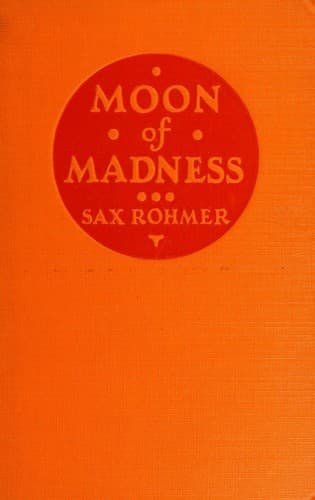
Adventure stories; English fiction -- 20th century; Love stories; Spy stories
“There is always room for three more passengers in any British liner,”
he replied: “a diplomatic agent, a King’s Messenger, and a pretty
woman.”
“What are you expected to do?” I asked.
“I am expected to prevent him landing!”
“But”--doubtless my expression became more blank than ever--“surely
the authorities at Southampton----”
“The authorities at Southampton don’t know in what name he is
travelling. Neither does Capetown, apparently. They merely know that
he’s on board--with a false passport. He made South Africa too hot to
hold him. Moscow’s idea seems to be that another Boer war would add to
the gaiety of nations. The Boers don’t seem to think so.”
He stirred languidly in the cane lounge chair and, raising his
monocle, surveyed a number of ants performing mysterious evolutions on
his white drill suit. It was very still and peaceful in the little
palm grove. A faint breeze carried perfume from the gardens, a sound
of distant voices and soft laughter. Outside the cool oasis in which
we sat, shaded, Madeira sunlight blazed on a million gay flowers, and
the low mossy walls were alive with lizards.
“Have you ever seen this man?” I asked.
“No,” O’Shea turned his head lazily. “I haven’t the slightest idea
what he looks like. Unless I get some further news by radio, my chance
of identifying this Red sportsman is a bad hundred to one.”
“But you say he has a false passport?”
“So I understand. Probably issued in Paris or Milan or even New York,
and in perfect order. Thousands of undesirables travel about the world
annually with other people’s passports, Decies. The appended
photograph is the only snag, and you might be surprised to learn how
easy it is to replace it and duplicate the official stamp.”
Presently I went hunting for Nanette. My guardianship of this dainty,
wayward ward was soon to cease; and whilst I lacked the courage to
think about saying good-bye at Southampton, I had learned that for a
man of my age and temperament the rôle of official uncle to a
beautiful girl was no sort of job.
Tea was in full swing on the terrace, but Nanette was not there. I
thought she might be on the tennis courts, and I strolled down the
steps and along the sloping, flower-gay path sacred to basking
lizards.
Halfway down there is a sort of abutment, overhanging the lower
gardens and possessing a stone seat. Here, in a lounge chair, her
parasol propped against the low wall, I saw Nanette.
Her little feet tucked up on the chair, to protect her bare legs from
the ants, she sat manicuring her finger nails.
She neither saw nor heard my approach. And I stood still watching her.
Quite mechanically she was polishing away with a chamois burnisher,
but her blue eyes were staring, unseeingly, out over the bay.
As I studied the charming, pensive profile, I wondered, as I had
wondered too often, what fate had in store for little Nanette. My more
immediate wonder was concerned with the problem of how she had
contrived to be alone.
Public-domain text, read in full here on John Shaqi.
Reviews
Reviews
No reviews yet
Be the first to share your thoughts on this work.
Join the Discussion
Join the discussion
Sign in to leave a comment or review.
Sign InorCreate an account