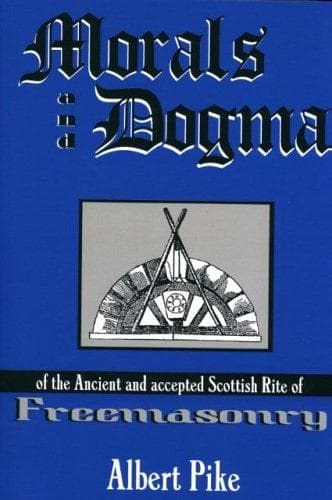
Morals and Dogma of the Ancient and Accepted Scottish Rite of FreemasonryPike, Albert
Religion
Morals and Dogma of the Ancient and Accepted Scottish Rite of Freemasonry
Pike, Albert
Freemasons
You entered the Lodge between two columns. They represent the two which
stood in the porch of the Temple, on each side of the great eastern
gateway. These pillars, of bronze, four fingers breadth in thickness,
were, according to the most authentic account--that in the First and
that in the Second Book of Kings, confirmed in Jeremiah--eighteen cubits
high, with a capital five cubits high. The shaft of each was four cubits
in diameter. A cubit is one foot 707/1000. That is, the shaft of each
was a little over thirty feet eight inches in height, the capital of
each a little over eight feet six inches in height, and the diameter of
the shaft six feet ten inches. The capitals were enriched by
pomegranates of bronze, covered by bronze net-work, and ornamented with
wreaths of bronze; and appear to have imitated the shape of the
seed-vessel of the lotus or Egyptian lily, a sacred symbol to the Hindus
and Egyptians. The pillar or column on the right, or in the south, was
named, as the Hebrew word is rendered in our translation of the Bible,
JACHIN: and that on the left BOAZ. Our translators say that the first
word means, "_He shall establish_;" and the second, "_In it is
strength._"
These columns were imitations, by Khūrūm, the Tyrian artist, of the
great columns consecrated to the Winds and Fire, at the entrance to the
famous Temple of Malkarth, in the city of Tyre. It is customary, in
Lodges of the York Rite, to see a celestial globe on one, and a
terrestrial globe on the other; but these are not warranted, if the
object be to imitate the original two columns of the Temple. The
symbolic meaning of these columns we shall leave for the present
unexplained, only adding that Entered Apprentices keep their
working-tools in the column JACHIN; and giving you the etymology and
literal meaning of the two names.
The word _Jachin_, in Hebrew, is [Hebrew]. It was probably pronounced
_Ya-kayan_, and meant, as a verbal noun, _He that strengthens_; and
thence, _firm, stable, upright_.
The word _Boaz_ is [Hebrew] Baaz. [Hebrew] means _Strong, Strength,
Power, Might, Refuge, Source of Strength, a Fort_. The [Hebrew] prefixed
means "_with_" or "_in_," and gives the word the force of the Latin
gerund, _roborando--Strengthening_.
The former word also means _he will establish_, or _plant in an erect
position_--from the verb [Hebrew] _Kūn, he stood erect_. It probably
meant _Active_ and _Vivifying Energy_ and _Force_; and _Boas, Stability,
Permanence_, in the _passive_ sense.
Public-domain text, read in full here on John Shaqi.
Reviews
Reviews
No reviews yet
Be the first to share your thoughts on this work.
Join the Discussion
Join the discussion
Sign in to leave a comment or review.
Sign InorCreate an account