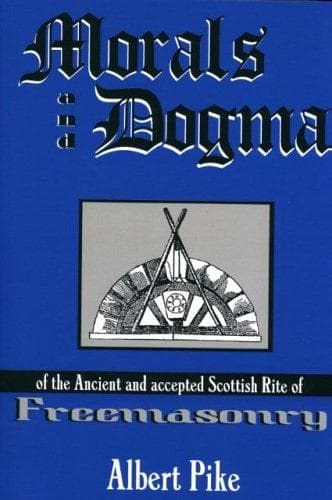
Morals and Dogma of the Ancient and Accepted Scottish Rite of FreemasonryPike, Albert
Religion
Morals and Dogma of the Ancient and Accepted Scottish Rite of Freemasonry
Pike, Albert
Freemasons
To this end it teaches this great and momentous truth: that wrong and
injustice once done cannot be undone; but are eternal in their
consequences; once committed, are numbered with the irrevocable Past;
that the wrong that is done _contains_ its own retributive penalty as
surely and as naturally as the acorn contains the oak. Its consequences
are its punishment; it needs no other, and can have no heavier; they are
involved in its commission, and cannot be separated from it. A wrong
done to another is an injury done to our own Nature, an offence against
our own souls, a disfiguring of the image of the Beautiful and Good.
Punishment is not the execution of a sentence, but the occurrence of an
effect. It is ordained to follow guilt, not by the decree of God as a
judge, but by a law enacted by Him as the Creator and Legislator of the
Universe. It is not an arbitrary and artificial annexation, but an
ordinary and logical consequence; and therefore must be borne by the
wrong-doer, and through him may flow on to others. It is the decision of
the infinite justice of God, in the form of law.
There can be no interference with, or remittance of, or protection from,
the natural effects of our wrongful acts. God will not interpose between
the cause and its consequence; and in that sense there can be no
forgiveness of sins. The act which has debased our soul may be repented
of, may be turned from; but the injury is done. The debasement may be
redeemed by after-efforts, the stain obliterated by bitterer struggles
and severer sufferings; but the efforts and the endurance which might
have raised the soul to the loftiest heights are now exhausted in merely
regaining what it has lost. There must always be a wide difference
between him who only ceases to do evil, and him who has always done
well.
He will certainly be a far more scrupulous watcher over his conduct, and
far more careful of his deeds, who believes that those deeds will
inevitably bear their natural consequences, exempt from after
intervention, than he who believes that penitence and pardon will at any
time unlink the chain of sequences. Surely we shall do less wrong and
injustice, if the conviction is fixed and embedded in our souls that
everything done is done irrevocably, that even the Omnipotence of God
cannot _uncommit_ a deed, cannot make that _undone_ which has _been
done_; that every act of ours _must_ bear its allotted fruit, according
to the everlasting laws,--must remain forever ineffaceably inscribed on
the tablets of Universal Nature.
Public-domain text, read in full here on John Shaqi.
Reviews
Reviews
No reviews yet
Be the first to share your thoughts on this work.
Elsewhere in the archive
Join the Discussion
Join the discussion
Sign in to leave a comment or review.
Sign InorCreate an account