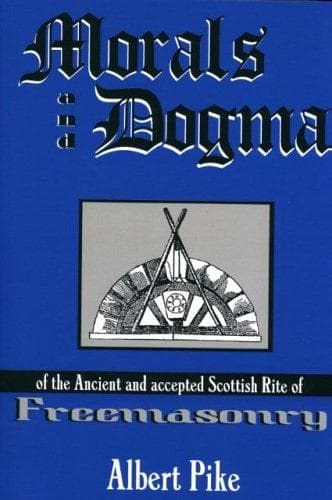
Morals and Dogma of the Ancient and Accepted Scottish Rite of FreemasonryPike, Albert
Religion
Morals and Dogma of the Ancient and Accepted Scottish Rite of Freemasonry
Pike, Albert
Freemasons
What is truth to _me_ is not truth to _another_. The same arguments and
evidences that convince one mind make no impression on another. This
difference is in men at their birth. No man is entitled positively to
assert that _he_ is right, where other men, equally intelligent and
equally well-informed, hold directly the opposite opinion. Each thinks
it impossible for the other to be sincere, and each, as to that, is
equally in error. "_What is truth_?" was a profound question, the most
suggestive one ever put to man. Many beliefs of former and present times
seem incomprehensible. They startle us with a new glimpse into the human
soul, that mysterious thing, more mysterious the more we note its
workings. Here is a man superior to myself in intellect and learning;
and yet he sincerely believes what seems to me too absurd to merit
confutation; and I cannot conceive, and sincerely do not believe, that
he is both sane and honest. _And yet he is both_. His reason is as
perfect as mine, and he is as honest as I.
The fancies of a lunatic are realities, _to him_. Our dreams are
realities _while they last_; and, in the Past, no more _un_real than
what we have acted in our waking hours. No man can say that he hath as
sure possession of the truth as of a chattel. When men entertain
opinions diametrically opposed to each other, and each is honest, who
shall decide which hath the Truth; and how can either say with certainty
that _he_ hath it? We know not what _is_ the truth. That we ourselves
believe and feel absolutely certain that our own belief is true, is in
reality not the slightest proof of the fact, seem it never so certain
and incapable of doubt to us. No man is responsible for the rightness of
his faith; but only for the _up_rightness of it.
Therefore no man hath or ever had a right to persecute another for his
belief; for there cannot be two antagonistic rights; and if one can
persecute another, because he himself is satisfied that the belief of
that other is erroneous, the other has, for the same reason, equally as
certain a right to persecute him.
The truth comes to us tinged and colored with our prejudices and our
preconceptions, which are as old as ourselves, and strong with a divine
force. It comes to us as the image of a rod comes to us through the
water, bent and distorted. An argument sinks into and convinces the mind
of one man, while from that of another it rebounds like a ball of ivory
dropped on marble. It is no merit in a man to have a particular faith,
excellent and sound and philosophic as it may be, when he imbibed it
with his mother's milk. It is no more a merit than his prejudices and
his passions.
Public-domain text, read in full here on John Shaqi.
Reviews
Reviews
No reviews yet
Be the first to share your thoughts on this work.
Elsewhere in the archive
Join the Discussion
Join the discussion
Sign in to leave a comment or review.
Sign InorCreate an account