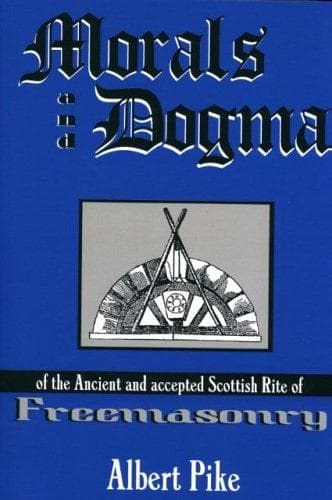
Morals and Dogma of the Ancient and Accepted Scottish Rite of FreemasonryPike, Albert
Religion
Morals and Dogma of the Ancient and Accepted Scottish Rite of Freemasonry
Pike, Albert
Freemasons
Masonry requires of its Initiates and votaries nothing that is
impracticable. It does not demand that they should undertake to climb to
those lofty and sublime peaks of a theoretical and imaginary unpractical
virtue, high and cold and remote as the eternal snows that wrap the
shoulders of Chimborazo, and at least as inaccessible as they. It asks
that alone to be done which is easy to be done. It overtasks no one's
strength, and asks no one to go beyond his means and capacities. It does
not expect one whose business or profession yields him little more than
the wants of himself and his family require, and whose time is
necessarily occupied by his daily vocations, to abandon or neglect the
business by which he and his children live, and devote himself and his
means to the diffusion of knowledge among men. It does not expect him to
publish books for the people, or to lecture, to the ruin of his private
affairs, or to found academies and colleges, build up libraries, and
entitle himself to statues.
But it does require and expect every man of us to do something, within
and according to his means; and there is no Mason who _cannot_ do _some_
thing, if not alone, then by combination and association.
If a Lodge cannot aid in founding a school or an academy it can still do
something. It can educate one boy or girl, at least, the child of some
poor or departed brother. And it should never be forgotten, that in the
poorest unregarded child that seems abandoned to ignorance and vice
_may_ slumber the virtues of a Socrates, the intellect of a Bacon or a
Bossuet, the genius of a Shakespeare, the capacity to benefit mankind of
a Washington; and that in rescuing him from the mire in which he is
plunged, and giving him the means of education and development, the
Lodge that does it may be the direct and immediate means of conferring
upon the world as great a boon as that given it by John Faust the boy of
Mentz; may perpetuate the liberties of a country and change the
destinies of nations, and write a new chapter in the history of the
world.
For we never know the importance of the act we do. The daughter of
Pharaoh little thought what she was doing for the human race, and the
vast unimaginable consequences that depended on her charitable act, when
she drew the little child of a Hebrew woman from among the rushes that
grew along the bank of the Nile, and determined to rear it as if it were
her own.
Public-domain text, read in full here on John Shaqi.
Reviews
Reviews
No reviews yet
Be the first to share your thoughts on this work.
Elsewhere in the archive
Join the Discussion
Join the discussion
Sign in to leave a comment or review.
Sign InorCreate an account