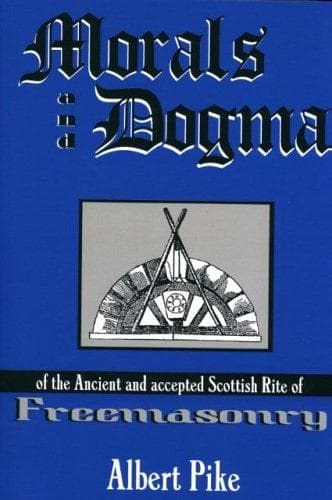
Morals and Dogma of the Ancient and Accepted Scottish Rite of FreemasonryPike, Albert
Religion
Morals and Dogma of the Ancient and Accepted Scottish Rite of Freemasonry
Pike, Albert
Freemasons
The poor man also is at school. Let him take care that he learn, rather
than complain. Let him hold to his integrity, his candor, and his
kindness of heart. Let him beware of envy, and of bondage, and keep his
self-respect. The body's toil is nothing. Let him beware of the mind's
drudgery and degradation. While he betters his condition if he can, let
him be more anxious to better his soul. Let him be willing, while poor,
and even if always poor, to learn poverty's great lessons, fortitude,
cheerfulness, contentment, and implicit confidence in God's Providence.
With these, and patience, calmness, self-command, disinterestedness, and
affectionate kindness, the humble dwelling may be hallowed, and made
more dear and noble than the loftiest palace. Let him, above all things,
see that he lose not his independence. Let him not cast himself, a
creature poorer than the poor, an indolent, helpless, despised beggar,
on the kindness of others. Every man should choose to have God for his
Master, rather than man; and escape not from this school, either by
dishonesty or alms-taking, lest he fall into that state, worse than
disgrace, where he can have no respect for himself.
The ties of Society teach us to love one another. That is a miserable
society, where the absence of affectionate kindness is sought to be
supplied by punctilious decorum, graceful urbanity, and polished
insincerity; where ambition, jealousy, and distrust rule, in place of
simplicity, confidence, and kindness.
So, too, the social state teaches modesty and gentleness; and from
neglect, and notice unworthily bestowed on others, and injustice, and
the world's failure to appreciate us, we learn patience and quietness,
to be superior to society's opinion, not cynical and bitter, but gentle,
candid, and affectionate still.
Death is the great Teacher, stern, cold, inexorable, irresistible; whom
the collected might of the world cannot stay or ward off. The breath,
that parting from the lips of King or beggar, scarcely stirs the hushed
air, cannot be bought, or brought back for a moment, with the wealth of
Empires. What a lesson is this, teaching our frailty and feebleness, and
an Infinite Power beyond us! It is a fearful lesson, that never becomes
familiar. It walks through the earth in dread mystery, and lays its
hands upon all. It is a universal lesson, that is read everywhere and by
all men. Its message comes every year and every day. The past years are
crowded with its sad and solemn mementoes; and death's finger traces its
handwriting upon the walls of every human habitation.
It teaches us Duty; to act our part well; to fulfill the work assigned
us. When one is dying, and after he is dead, there is but one question:
_Has he lived well?_ There is no evil in death but that which life
makes.
Public-domain text, read in full here on John Shaqi.
Reviews
Reviews
No reviews yet
Be the first to share your thoughts on this work.
Elsewhere in the archive
Join the Discussion
Join the discussion
Sign in to leave a comment or review.
Sign InorCreate an account