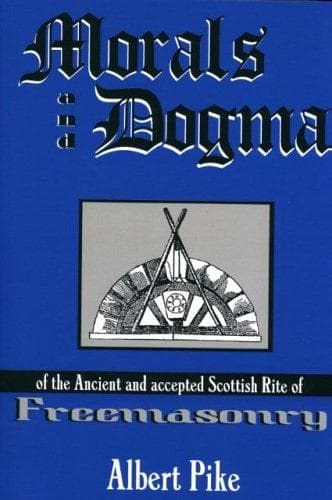
Morals and Dogma of the Ancient and Accepted Scottish Rite of FreemasonryPike, Albert
Religion
Morals and Dogma of the Ancient and Accepted Scottish Rite of Freemasonry
Pike, Albert
Freemasons
In what Lodge are our ceremonies explained and elucidated; corrupted as
they are by time, until their true features can scarcely be
distinguished; and where are those great primitive truths of revelation
taught, which Masonry has preserved to the world?
We have high dignities and sounding titles. Do their possessors qualify
themselves to enlighten the world in respect to the aims and objects of
Masonry? Descendants of those Initiates who governed empires, does your
influence enter into practical life and operate efficiently in behalf of
well-regulated and constitutional liberty?
Your debates should be but friendly conversations. You need concord,
union, and peace. Why then do you retain among you men who excite
rivalries and jealousies; why permit great and violent controversy and
ambitious pretensions? How do your own words and acts agree? If your
Masonry is a nullity, how can you exercise any influence on others?
Continually you praise each other, and utter elaborate and high-wrought
eulogies upon the Order. Everywhere you assume that you are what you
should be, and nowhere do you look upon yourselves as you are. Is it
true that all our actions are so many acts of homage to virtue? Explore
the recesses of your hearts; let us examine ourselves with an impartial
eye, and make answer to our own questioning! Can we bear to ourselves
the consoling testimony that we always rigidly perform our duties; that
we even _half_ perform them?
Let us away with this odious self-flattery! Let us be men, if we cannot
be sages! The laws of Masonry, above others excellent, cannot wholly
change men's natures. They enlighten them, they point out the true way;
but they can lead them in it, only by repressing the fire of their
passions, and subjugating their selfishness. Alas, these conquer, and
Masonry is forgotten!
After praising each other all our lives, there are always excellent
Brethren, who, over our coffins, shower unlimited eulogies. Every one of
us who dies, however useless his life, has been a model of all the
virtues, a very child of the celestial light. In Egypt, among our old
Masters, where Masonry was more cultivated than vanity, no one could
gain admittance to the sacred asylum of the tomb until he had passed
under the most solemn judgment. A grave tribunal sat in judgment upon
all, even the kings. They said to the dead, "Whoever thou art, give
account to thy country of thy actions! What hast thou done with thy time
and life? The law interrogates thee, thy country hears thee, Truth sits
in judgment on thee!" Princes came there to be judged, escorted only by
their virtues and their vices. A public accuser recounted the history of
the dead man's life, and threw the blaze of the torch of truth on all
his actions. If it were adjudged that he had led an evil life, his
memory was condemned in the presence of the nation, and his body was
denied the honors of sepulture. What a lesson the old Masonry taught to
the sons of the people!
Public-domain text, read in full here on John Shaqi.
Reviews
Reviews
No reviews yet
Be the first to share your thoughts on this work.
Elsewhere in the archive
Join the Discussion
Join the discussion
Sign in to leave a comment or review.
Sign InorCreate an account