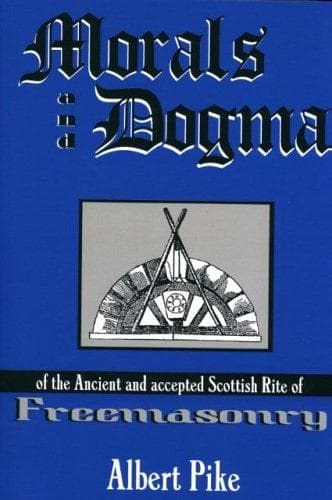
Morals and Dogma of the Ancient and Accepted Scottish Rite of FreemasonryPike, Albert
Religion
Morals and Dogma of the Ancient and Accepted Scottish Rite of Freemasonry
Pike, Albert
Freemasons
To pity the misfortunes of others; to be humble, but without meanness;
to be proud, but without arrogance; to abjure every sentiment of hatred
and revenge; to show himself magnanimous and liberal, without
ostentation and without profusion; to be the enemy of vice; to pay
homage to wisdom and virtue; to respect innocence; to be constant and
patient in adversity, and modest in prosperity; to avoid every
irregularity that stains the soul and distempers the body--it is by
following these precepts that a Mason will become a good citizen, a
faithful husband, a tender father, an obedient son, and a true brother;
will honor friendship, and fulfill with ardor the duties which virtue
and the social relations impose upon him.
It is because Masonry imposes upon us these duties that it is properly
and significantly styled _work_; and he who imagines that he becomes a
Mason by merely taking the first two or three Degrees, and that he may,
having leisurely stepped upon that small elevation, thenceforward
worthily wear the honors of Masonry, without labor or exertion, or
self-denial or sacrifice, and that there is nothing to be _done_ in
Masonry, is strangely deceived.
Is it true that nothing remains to be done in Masonry?
Does one Brother no longer proceed by law against another Brother of his
Lodge, in regard to matters that could be easily settled within the
Masonic family circle?
Has the duel, that hideous heritage of barbarism, interdicted among
Brethren by our fundamental laws, and denounced by the municipal code,
yet disappeared from the soil we inhabit? Do Masons of high rank
religiously refrain from it; or do they not, bowing to a corrupt public
opinion, submit to its arbitrament, despite the scandal which it
occasions to the Order, and in violation of the feeble restraint of
their oath?
Do Masons no longer form uncharitable opinions of their Brethren, enter
harsh judgments against them, and judge themselves by one rule and their
Brethren by another?
Has Masonry any well-regulated system of charity? Has it done that which
it should have done for the cause of education? Where are its schools,
its academies, its colleges, its hospitals, and infirmaries?
Are political controversies now conducted with no violence and
bitterness?
Do Masons refrain from defaming and denouncing their Brethren who differ
with them in religious or political opinions?
What grand social problems or useful projects engage our attention at
our communications? Where in our Lodges are lectures habitually
delivered for the real instruction of the Brethren? Do not our sessions
pass in the discussion of minor matters of business, the settlement of
points of order and questions of mere administration, and the admission
and advancement of Candidates, whom after their admission we take no
pains to instruct?
Public-domain text, read in full here on John Shaqi.
Reviews
Reviews
No reviews yet
Be the first to share your thoughts on this work.
Elsewhere in the archive
Join the Discussion
Join the discussion
Sign in to leave a comment or review.
Sign InorCreate an account