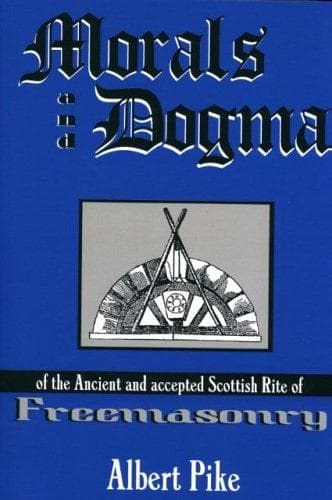
Morals and Dogma of the Ancient and Accepted Scottish Rite of FreemasonryPike, Albert
Religion
Morals and Dogma of the Ancient and Accepted Scottish Rite of Freemasonry
Pike, Albert
Freemasons
Among _all_ the ancient nations there was one faith and one idea of
Deity for the enlightened, intelligent, and educated, and another for
the common people. To this rule the Hebrews were no exception. Yehovah,
to the mass of the people, was like the gods of the nations around them,
except that he was the _peculiar_ God, first of the family of Abraham,
of that of Isaac, and of that of Jacob, and afterward the _National_
God; and, as they believed, _more powerful_ than the other gods of the
same nature worshipped by their neighbors--"Who among the Baalim is
like unto thee, O Yehovah?"--expressed their whole creed.
The Deity of the early Hebrews talked to Adam and Eve in the garden of
delight, as he walked in it in the cool of the day; he conversed with
Kayin; he sat and ate with Abraham in his tent; that patriarch required
a visible token, before he would believe in his positive promise; he
permitted Abraham to expostulate with him, and to induce him to change
his first determination in regard to Sodom; he wrestled with Jacob; he
showed Moses his person, though not his face; he dictated the minutest
police regulations and the dimensions of the tabernacle and its
furniture, to the Israelites; he insisted on and delighted in sacrifices
and burnt-offerings; he was angry, jealous, and revengeful, as well as
wavering and irresolute; he allowed Moses to reason him out of his fixed
resolution utterly to destroy his people; he commanded the performance
of the most shocking and hideous acts of cruelty and barbarity. He
hardened the heart of Pharaoh; he repented of the evil that he had said
he would do unto the people of Nineveh; and he did it not, to the
disgust and anger of Jonah.
Such were the popular notions of the Deity; and either the priests had
none better, or took little trouble to correct these notions; or the
popular intellect was not enough enlarged to enable them to entertain
any higher conceptions of the Almighty.
But such were not the ideas of the intellectual and enlightened few
among the Hebrews, It is certain that _they_ possessed a knowledge of
the true nature and attributes of God; as the same class of men did
among the other nations--Zoroaster, Menu, Confucius, Socrates, and
Plato. But their doctrines on this subject were esoteric; they did not
communicate them to the people at large, but only to a favored few; and
as they were communicated in Egypt and India, in Persia and Phœnicia, in
Greece and Samothrace, in the greater mysteries, to the Initiates.
Public-domain text, read in full here on John Shaqi.
Reviews
Reviews
No reviews yet
Be the first to share your thoughts on this work.
Elsewhere in the archive
Join the Discussion
Join the discussion
Sign in to leave a comment or review.
Sign InorCreate an account