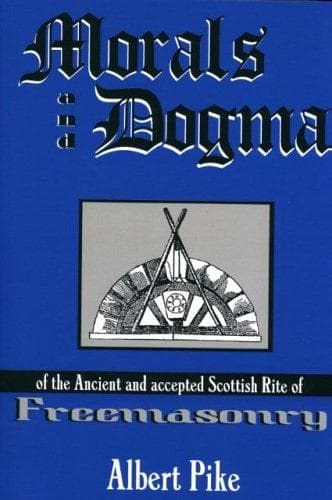
Morals and Dogma of the Ancient and Accepted Scottish Rite of FreemasonryPike, Albert
Religion
Morals and Dogma of the Ancient and Accepted Scottish Rite of Freemasonry
Pike, Albert
Freemasons
The ancient symbols and allegories always had more than one
interpretation. They always had a _double_ meaning, and sometimes _more_
than two, one serving as the envelope of the other. Thus the
_pronunciation_ of the word was a symbol; and that pronunciation and the
word itself were lost, when the knowledge of the true nature and
attributes of God faded out of the minds of the Jewish people. That is
_one_ interpretation--_true, but not the inner and profoundest one_.
Men were figuratively said to forget the _name_ of God, when they lost
that _knowledge_, and worshipped the heathen deities, and burned incense
to them on the high places, and passed their children through the fire
to Moloch.
Thus the attempts of the ancient Israelites and of the Initiates to
ascertain the True Name of the Deity, and its pronunciation, and the
loss of the True Word, are an allegory, in which are represented the
general ignorance of the true nature and attributes of God, the
proneness of the people of Judah and Israel to worship other deities,
and the low and erroneous and dishonoring notions of the Grand Architect
of the Universe, which all shared except a few favored persons; for even
Solomon built altars and sacrificed to Astarat, the goddess of the
Tsidunim, and Malcūm, the Aamūnite god, and built high places for Kamūs,
the Moabite deity, and Malec the god of the Beni-Aamūn. The true nature
of God was unknown to them, like His name; and they worshipped the
calves of Jeroboam, as in the desert they did that made for them by
Aarūn.
The mass of the Hebrews did not believe in the existence of one only God
until a late period in their history. Their early and popular ideas of
the Deity were singularly low and unworthy. Even while Moses was
receiving the law upon Mount Sinai, they forced Aarūn to make them an
image of the Egyptian god Apis, and fell down and adored it. They were
ever ready to return to the worship of the gods of the Mitzraim; and
soon after the death of Joshua they became devout worshippers of the
false gods of all the surrounding nations. "Ye have borne," Amos, the
prophet, said to them, speaking of their forty years' journeying in the
desert, under Moses, "the tabernacle of your Malec and Kaiūn your idols,
the star of your god, which ye made to yourselves".
Among them, as among other nations, the conceptions of God formed by
individuals varied according to their intellectual and spiritual
capacities; poor and imperfect, and investing God with the commonest and
coarsest attributes of humanity, among the ignorant and coarse; pure and
lofty among the virtuous and richly gifted. These conceptions gradually
improved and became purified and ennobled, as the nation advanced in
civilization--being lowest in the historical books, amended in the
prophetic writings, and reaching their highest elevation among the
poets.
Public-domain text, read in full here on John Shaqi.
Reviews
Reviews
No reviews yet
Be the first to share your thoughts on this work.
Elsewhere in the archive
Join the Discussion
Join the discussion
Sign in to leave a comment or review.
Sign InorCreate an account