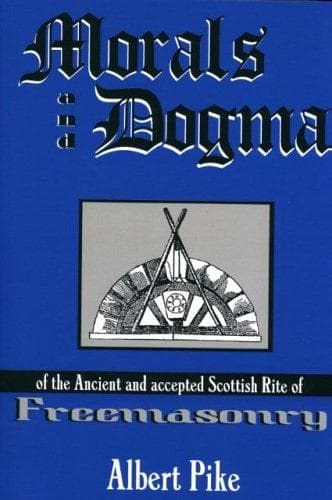
Morals and Dogma of the Ancient and Accepted Scottish Rite of FreemasonryPike, Albert
Religion
Morals and Dogma of the Ancient and Accepted Scottish Rite of Freemasonry
Pike, Albert
Freemasons
And so in our day every Masonic Lodge represents the Universe. Each
extends, we are told, from the rising to the setting sun, from the South
to the North, from the surface of the Earth to the Heavens, and from the
same to the centre of the globe. In it are represented the sun, moon,
and stars; three great torches in the East, West, and South, forming a
triangle, give it light; and, like the Delta or Triangle suspended in
the East, and inclosing the Ineffable Name, indicate, by the
mathematical equality of the angles and sides, the beautiful and
harmonious proportions which govern in the aggregate and details of the
Universe; while those sides and angles represent, by their number,
three, the Trinity of Power, Wisdom, and Harmony, which presided at the
building of this marvellous work. These three great lights also
represent the great mystery of the three principles, of creation,
dissolution or destruction, and reproduction or regeneration,
consecrated by all creeds in their numerous Trinities.
The luminous pedestal, lighted by the perpetual flame within, is a
symbol of that light of _Reason_, given by God to man, by which he is
enabled to read in the Book of Nature the record of the thought, the
revelation of the attributes of the Deity.
The three Masters, Adoniram, Joabert, and Stolkin, are types of the True
Mason, who seeks for knowledge from pure motives, and that he may be the
better enabled to serve and benefit his fellow-men; while the
discontented and presumptuous Masters who were buried in the ruins of
the arches represent those who strive to acquire it for unholy purposes,
to gain power over their fellows, to gratify their pride, their vanity,
or their ambition.
The Lion that guarded the Ark and held in his mouth the key wherewith to
open it, figuratively represents Solomon, the Lion of the Tribe of
Judah, who preserved and communicated the key to the true knowledge of
God, of His laws, and of the profound mysteries of the moral and
physical Universe.
ENOCH [[Hebrew: חנוך], Khanōc], we are told, walked with God three
hundred years, after reaching the age of sixty-five--"walked with God,
and he was no more, for God had taken him." His name signified in the
Hebrew, INITIATE or INITIATOR. The legend of the columns, of granite and
brass or bronze, erected by him, is probably symbolical. That of bronze,
which survived the flood, is supposed to symbolize the mysteries, of
which Masonry is the legitimate successor--from the earliest times the
custodian and depository of the great philosophical and religious
truths, unknown to the world at large, and handed down from age to age
by an unbroken current of tradition, embodied in symbols, emblems, and
allegories.
Public-domain text, read in full here on John Shaqi.
Reviews
Reviews
No reviews yet
Be the first to share your thoughts on this work.
Elsewhere in the archive
Join the Discussion
Join the discussion
Sign in to leave a comment or review.
Sign InorCreate an account