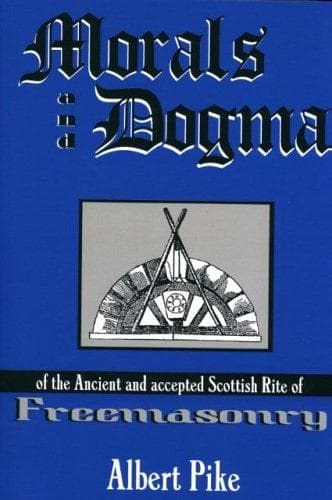
Morals and Dogma of the Ancient and Accepted Scottish Rite of FreemasonryPike, Albert
Religion
Morals and Dogma of the Ancient and Accepted Scottish Rite of Freemasonry
Pike, Albert
Freemasons
The legend of this Degree is thus, partially, interpreted. It is of
little importance whether it is in anywise historical. For its value
consists in the lessons which it inculcates, and the duties which it
prescribes to those who receive it. The parables and allegories of the
Scriptures are not less valuable than history. Nay, they are more so,
because ancient history is little instructive, and truths are concealed
in and symbolized by the legend and the myth. There are profounder
meanings concealed in the symbols of this Degree, connected with the
philosophical system of the Hebrew Kabalists, which you will learn
hereafter, if you should be so fortunate as to advance. They are
unfolded in the higher Degrees. The _lion_ [[Hebrew: אריה,ארי] _Arai_,
_Araiah_, which also means the _altar_] still holds in his mouth the key
of the enigma of the sphynx.
But there is one application of this Degree, that you are now entitled
to know; and which, remembering that Khūrūm, the Master, is the symbol
of human freedom, you would probably discover for yourself.
It is not enough for a people to _gain_ its liberty. It must _secure_
it. It must not intrust it to the keeping, or hold it at the pleasure,
of any one man. The keystone of the Royal Arch of the great Temple of
Liberty is a fundamental law, charter, or constitution; the expression
of the fixed habits of thought of the people, embodied in a written
instrument, or the result of the slow accretions and the consolidation
of centuries; the same in war as in peace; that cannot be hastily
changed, nor be violated with impunity, but is sacred, like the Ark of
the Covenant of God, which none could touch and live.
A permanent constitution, rooted in the affections, expressing the will
and judgment, and built upon the instincts and settled habits of thought
of the people, with an independent judiciary, an elective legislature of
two branches, an executive responsible to the people, and the right of
trial by jury, will guarantee the liberties of a people, if it be
virtuous and temperate, without luxury, and without the lust of conquest
and dominion, and the follies of visionary theories of impossible
perfection.
Public-domain text, read in full here on John Shaqi.
Reviews
Reviews
No reviews yet
Be the first to share your thoughts on this work.
Elsewhere in the archive
Join the Discussion
Join the discussion
Sign in to leave a comment or review.
Sign InorCreate an account