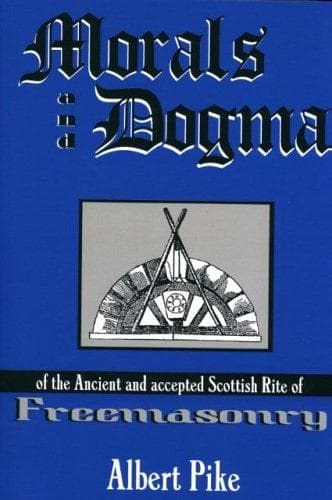
Morals and Dogma of the Ancient and Accepted Scottish Rite of FreemasonryPike, Albert
Religion
Morals and Dogma of the Ancient and Accepted Scottish Rite of Freemasonry
Pike, Albert
Freemasons
Masonry teaches its Initiates that the pursuits and occupations of this
life, its activity, care, and ingenuity, the predestined developments of
the nature given us by God, tend to promote His great design, in making
the world; and are not at war with the great purpose of life. It teaches
that everything is beautiful in its time, in its place, in its appointed
office; that everything which man is put to do, if rightly and
faithfully done, naturally helps to work out his salvation; that if he
obeys the genuine principles of his calling, he will be a good man: and
that it is only by neglect and non-performance of the task set for him
by Heaven, by wandering into idle dissipation, or by violating their
beneficent and lofty spirit, that he becomes a bad man. The appointed
action of life is the great training of Providence; and if man yields
himself to it, he will need neither churches nor ordinances, except for
the _expression_ of his religious homage and gratitude.
For there is a religion of toil. It is not all drudgery, a mere
stretching of the limbs and straining of the sinews to tasks. It has a
meaning and an intent. A living heart pours life-blood into the toiling
arm; and warm affections inspire and mingle with man's labors. They are
the _home_ affections. Labor toils a-field, or plies its task in cities,
or urges the keels of commerce over wide oceans; but home is its centre;
and thither it ever goes with its earnings, with the means of support
and comfort for others; offerings sacred to the thought of every true
man, as a sacrifice at a golden shrine. Many faults there are amidst the
toils of life; many harsh and hasty, words are uttered; but still the
toils go on, weary and hard and exasperating as they often are. For in
that home is age or sickness, or helpless infancy, or gentle childhood,
or feeble woman, that must not want. If man had no other than mere
selfish impulses, the scene of labor which we behold around us would not
exist.
The advocate who fairly and honestly presents his case, with a feeling
of true self-respect, honor, and conscience, to help the tribunal on
towards the right conclusion, with a conviction that God's justice
reigns there, is acting a religious part, leading that day a religious
life; or else right and justice are no part of religion. Whether, during
all that day, he has once appealed, in form or in terms, to his
conscience, or not; whether he has once spoken of religion and God, or
not; if there has been the inward purpose, the conscious intent and
desire, that sacred justice should triumph, he has that day led a good
and _religious_ life, and made a most essential contribution to that
religion of life and of society, the cause of equity between man and
man, and of truth and right action in the world.
Public-domain text, read in full here on John Shaqi.
Reviews
Reviews
No reviews yet
Be the first to share your thoughts on this work.
Elsewhere in the archive
Join the Discussion
Join the discussion
Sign in to leave a comment or review.
Sign InorCreate an account