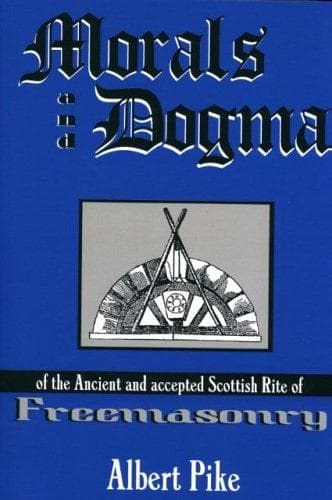
Morals and Dogma of the Ancient and Accepted Scottish Rite of FreemasonryPike, Albert
Religion
Morals and Dogma of the Ancient and Accepted Scottish Rite of Freemasonry
Pike, Albert
Freemasons
The Mason does not war with his own instincts, macerate the body into
weakness and disorder, and disparage what he sees to be beautiful,
knows to be wonderful, and feels to be unspeakably dear and fascinating.
He does not put aside the nature which God has given him, to struggle
after one which He has _not_ bestowed. He knows that man is sent into
the world, not a spiritual, but a composite being, made up of body and
mind, the body having, as is fit and needful in a material world, its
full, rightful, and allotted share. His life is guided by a full
recognition of this fact. He does not deny it in bold words, and admit
it in weaknesses and inevitable failings. He believes that his
spirituality will come in the next stage of his being, when he puts on
the spiritual body; that his body will be dropped at death; and that,
until then, God meant it to be commanded and controlled, but not
neglected, despised, or ignored by the soul, under pain of heavy
consequences.
Yet the Mason is not indifferent as to the fate of the soul, after its
present life, as to its continued and eternal being, and the character
of the scenes in which that being will be fully developed. These are to
him topics of the profoundest interest, and the most ennobling and
refining contemplation. They occupy much of his leisure; and as he
becomes familiar with the sorrows and calamities of this life, as his
hopes are disappointed and his visions of happiness here fade away; when
life has wearied him in its race of hours; when he is harassed and
toil-worn, and the burden of his years weighs heavy on him, the balance
of attraction gradually inclines in favor of another life; and he clings
to his lofty speculations with a tenacity of interest which needs no
injunction, and will listen to no prohibition. They are the consoling
privilege of the aspiring, the wayworn, the weary, and the bereaved.
To him the contemplation of the Future lets in light upon the Present,
and develops the higher portions of his nature. He endeavors rightly to
adjust the respective claims of Heaven and earth upon his time and
thought, so as to give the proper proportions thereof to performing the
duties and entering into the interests of this world, and to preparation
for a better; to the cultivation and purification of his own character,
and to the public service of his fellow-men.
The Mason does not dogmatize, but entertaining and uttering his own
convictions, he leaves everyone else free to do the same; and only hopes
that the time will come, even if after the lapse of ages, when all men
shall form one great family of brethren, and one law alone, the law of
love, shall govern God's whole Universe.
Public-domain text, read in full here on John Shaqi.
Reviews
Reviews
No reviews yet
Be the first to share your thoughts on this work.
Elsewhere in the archive
Join the Discussion
Join the discussion
Sign in to leave a comment or review.
Sign InorCreate an account