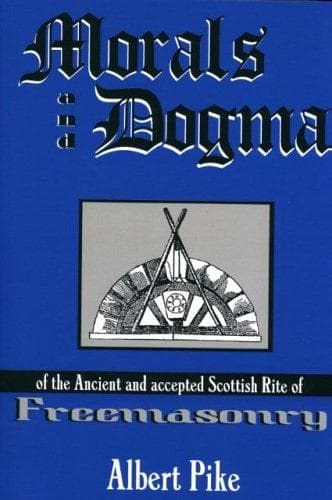
Morals and Dogma of the Ancient and Accepted Scottish Rite of FreemasonryPike, Albert
Religion
Morals and Dogma of the Ancient and Accepted Scottish Rite of Freemasonry
Pike, Albert
Freemasons
This, Masonry teaches, as a great Truth; a great moral landmark, that
ought to guide the course of all mankind. It teaches its toiling
children that the scene of their daily life is all spiritual, that the
very implements of their toil, the fabrics they weave, the merchandise
they barter, are designed for spiritual ends; that so believing, their
daily lot may be to them a sphere for the noblest improvement. That
which we do in our intervals of relaxation, our church-going, and our
book-reading, are especially designed to prepare our minds for the
_action_ of Life. We are to hear and read and meditate, that we may
_act_ well; and the _action_ of Life is itself the great field for
spiritual improvement. There is no task of industry or business, in
field or forest, on the wharf or the ship's deck, in the office or the
exchange, but has spiritual ends. There is no care or cross of our daily
labor, but was especially ordained to nurture in us patience, calmness,
resolution, perseverance, gentleness, disinterestedness, magnanimity.
Nor is there any tool or implement of toil, but is a part of the great
spiritual instrumentality.
All the relations of life, those of parent, child, brother, sister,
friend, associate, lover and beloved, husband, wife, are moral,
throughout every living tie and thrilling nerve that bind them together.
They cannot subsist a day nor an hour without putting the mind to a
trial of its truth, fidelity, forbearance, and disinterestedness.
A great city is one extended scene of moral action. There is no blow
struck in it but has a purpose, ultimately good or bad, and therefore
moral. There is no action performed, but has a motive; and motives are
the special jurisdiction of morality. Equipages, houses, and furniture
are symbols of what is moral, and they in a thousand ways minister to
right or wrong feeling. Everything that belongs to us, ministering to
our comfort or luxury, awakens in us emotions of pride or gratitude, of
selfishness or vanity; thoughts of self-indulgence, or merciful
remembrances of the needy and the destitute.
Everything acts upon and influences us. God's great law of sympathy and
harmony is potent and inflexible as His law of gravitation. A sentence
embodying a noble thought stirs our blood; a noise made by a child frets
and exasperates us, and influences our actions.
A world of spiritual objects, influences, and relations lies around us
all. We all vaguely deem it to be so; but he only lives a charmed life,
like that of genius and poetic inspiration, who communes with the
spiritual scene around him, hears the voice of the spirit in every
sound, sees its signs in every passing form of things, and feels its
impulse in all action, passion, and being. Very near to us lies the
mines of wisdom; unsuspected they lie all around us. There is a secret
in the simplest things, a wonder in the plainest, a charm in the
dullest.
Public-domain text, read in full here on John Shaqi.
Reviews
Reviews
No reviews yet
Be the first to share your thoughts on this work.
Elsewhere in the archive
Join the Discussion
Join the discussion
Sign in to leave a comment or review.
Sign InorCreate an account