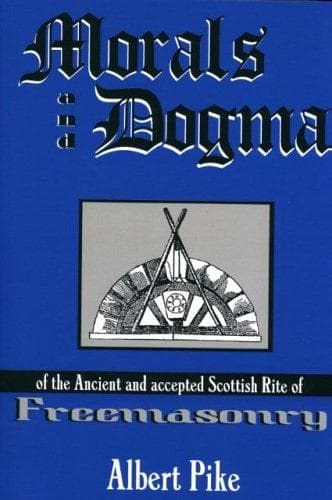
Morals and Dogma of the Ancient and Accepted Scottish Rite of FreemasonryPike, Albert
Religion
Morals and Dogma of the Ancient and Accepted Scottish Rite of Freemasonry
Pike, Albert
Freemasons
Pythagoras and Plato, the most mystical of the Grecian Philosophers (the
latter heir to the doctrines of the former), and who had travelled, the
latter in Egypt, and the former in Phœnicia, India, and Persia, also
taught the esoteric doctrine and the distinction between the initiated
and the profane. The dominant doctrines of Platonism were found in
Gnosticism. Emanation of Intelligences from the bosom of the Deity; the
going astray in error and the sufferings of spirits, so long as they are
remote from God, and imprisoned in matter; vain and long-continued
efforts to arrive at the knowledge of the Truth, and re-enter into their
primitive union with the Supreme Being; alliance of a pure and divine
soul with an irrational soul, the seat of evil desires; angels or demons
who dwell in and govern the planets, having but an imperfect knowledge
of the ideas that presided at the creation; regeneration of all beings
by their return to the [[Greek: κόσμος νοητός], kosmos noētos], the
world of Intelligences, and its Chief, the Supreme Being; sole possible
mode of re-establishing that primitive harmony of the creation, of
which the music of the spheres of Pythagoras was the image; these were
the analogies of the two systems; and we discover in them some of the
ideas that form a part of Masonry; in which, in the present mutilated
condition of the symbolic Degrees, they are disguised and overlaid with
fiction and absurdity, or present themselves as casual hints that are
passed by wholly unnoticed.
The distinction between the esoteric and exoteric doctrines (a
distinction purely Masonic), was always and from the very earliest times
preserved among the Greeks. It remounted to the fabulous times of
Orpheus; and the mysteries of Theosophy were found in all their
traditions and myths. And after the time of Alexander, they resorted for
instruction, dogmas, and mysteries, to all the schools, to those of
Egypt and Asia, as well as those of Ancient Thrace, Sicily, Etruria, and
Attica.
Public-domain text, read in full here on John Shaqi.
Reviews
Reviews
No reviews yet
Be the first to share your thoughts on this work.
Elsewhere in the archive
Join the Discussion
Join the discussion
Sign in to leave a comment or review.
Sign InorCreate an account