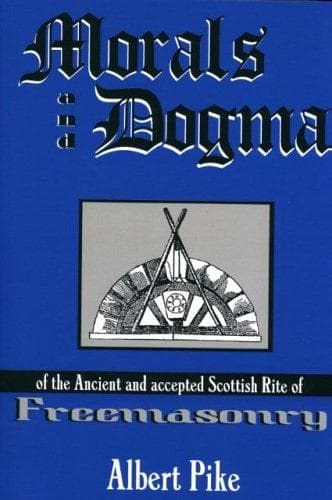
Morals and Dogma of the Ancient and Accepted Scottish Rite of FreemasonryPike, Albert
Religion
Morals and Dogma of the Ancient and Accepted Scottish Rite of Freemasonry
Pike, Albert
Freemasons
They styled themselves _Interpreters_; a name indicating their claim to
the exclusive possession of the true meaning of the Holy Writings, by
virtue of the oral tradition which Moses had received on Mount Sinai,
and which successive generations of Initiates had transmitted, as they
claimed, unaltered, unto them. Their very costume, their belief in the
influences of the stars, and in the immortality and transmigration of
souls, their system of angels and their astronomy, were all foreign.
Sadduceeism arose merely from an opposition essentially Jewish, to these
foreign teachings, and that mixture of doctrines, adopted by the
Pharisees, and which constituted the popular creed.
We come at last to the _Essenes_ and _Therapeuts_, with whom this Degree
is particularly concerned. That intermingling of oriental and occidental
rites, of Persian and Pythagorean opinions, which we have pointed out in
the doctrines of Philo, is unmistakable in the creeds of these two
sects.
They were less distinguished by metaphysical speculations than by simple
meditations and moral practices. But the latter always partook of the
Zoroastrian principle, that it was necessary to free the soul from the
trammels and influences of matter; which led to a system of abstinence
and maceration entirely opposed to the ancient Hebraic ideas, favorable
as they were to physical pleasures.
In general, the life and manners of these mystical associations, as
Philo and Josephus describe them, and particularly their prayers at
sunrise, seem the image of what the Zend-Avesta prescribes to the
faithful adorer of Ormuzd; and some of their observances cannot
otherwise be explained.
The Therapeuts resided in Egypt, in the neighborhood of Alexandria; and
the Essenes in Palestine, in the vicinity of the Dead Sea. But there was
nevertheless a striking coincidence in their ideas, readily explained by
attributing it to a foreign influence. The Jews of Egypt, under the
influence of the School of Alexandria, endeavored in general to make
their doctrines harmonize with the traditions of Greece; and thence
came, in the doctrines of the Therapeuts, as stated by Philo, the many
analogies between the Pythagorean and Orphic ideas, on one side, and
those of Judaism on the other: while the Jews of Palestine, having less
communication with Greece, or contemning its teachings, rather imbibed
the Oriental doctrines, which they drank in at the source and with which
their relations with Persia made them familiar. This attachment was
particularly shown in the Kabalah, which belonged rather to Palestine
than to Egypt, though extensively known in the latter; and furnished the
Gnostics with some of their most striking theories.
Public-domain text, read in full here on John Shaqi.
Reviews
Reviews
No reviews yet
Be the first to share your thoughts on this work.
Elsewhere in the archive
Join the Discussion
Join the discussion
Sign in to leave a comment or review.
Sign InorCreate an account