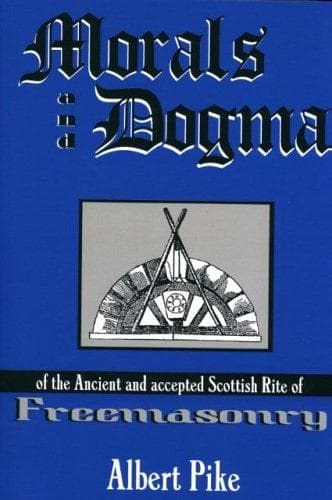
Morals and Dogma of the Ancient and Accepted Scottish Rite of FreemasonryPike, Albert
Religion
Morals and Dogma of the Ancient and Accepted Scottish Rite of Freemasonry
Pike, Albert
Freemasons
It is a significant fact, that while Christ spoke often of the Pharisees
and Sadducees, He never once mentioned the Essenes, between whose
doctrines and His there was so great a resemblance, and, in many points,
so perfect an identity. Indeed, they are not named, nor even distinctly
alluded to, anywhere in the New Testament.
John, the son of a Priest who ministered in the Temple at Jerusalem, and
whose mother was of the family of Aharun, was in the deserts until the
day of his showing unto Israel. He drank neither wine nor strong drink.
Clad in hair-cloth, and with a girdle of leather, and feeding upon such
food as the desert afforded, he preached, in the country about Jordan,
the baptism of repentance, for the remission of siri-s; that is, the
necessity of repentance proven by _reformation_. He taught the people
charity and liberality; the publicans, justice, equity, and fair
dealing; the soldiery, peace, truth, and contentment; to do violence to
none, accuse none falsely, and be content with their pay. He inculcated
the necessity of a virtuous life, and the folly of trusting to their
descent from Abraham.
He denounced both Pharisees and Sadducees as a generation of vipers,
threatened with the anger of God. He baptized those who confessed their
sins. He preached in the desert; and therefore in the country where the
Essenes lived, professing the same doctrines. He was imprisoned before
Christ began to preach. Matthew mentions him without preface or
explanation; as if, apparently, his history was too well known to need
any. "In those days," he says, "came John the Baptist, preaching in the
wilderness of Judea." His disciples frequently fasted; for we find them
with the Pharisees coming to Jesus to inquire why _His_ Disciples did
not fast as often as they; and He did not denounce _them_, as His habit
was to denounce the Pharisees; but answered them kindly and gently.
From his prison, John sent two of his disciples to inquire of Christ:
"Art thou he that is to come, or do we look for another?" Christ
referred them to his miracles as an answer; and declared to the people
that John was a prophet, and more than a prophet, and that no greater
man had ever been born; but that the humblest Christian was his
superior. He declared him to be Elias, who was to come.
John had denounced to Herod his marriage with his brother's wife as
unlawful; and for this he was imprisoned, and finally executed to
gratify her. His disciples buried him; and Herod and others thought he
had risen from the dead and appeared again in the person of Christ. The
people all regarded John as a prophet; and Christ silenced the Priests
and Elders by asking them whether he was inspired. They feared to excite
the anger of the people by saying that he was not. Christ declared that
he came "in the way of righteousness"; and that the lower classes
believed him, though the Priests and Pharisees did not.
Public-domain text, read in full here on John Shaqi.
Reviews
Reviews
No reviews yet
Be the first to share your thoughts on this work.
Elsewhere in the archive
Join the Discussion
Join the discussion
Sign in to leave a comment or review.
Sign InorCreate an account