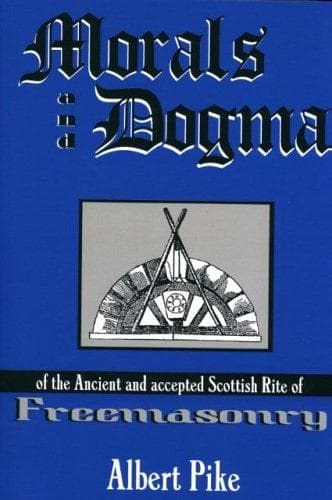
Morals and Dogma of the Ancient and Accepted Scottish Rite of FreemasonryPike, Albert
Religion
Morals and Dogma of the Ancient and Accepted Scottish Rite of Freemasonry
Pike, Albert
Freemasons
Thus John, who was often consulted by Herod, and to whom that monarch
showed great deference, and was often governed by his advice; whose
doctrine prevailed very extensively among the people and the publicans,
taught _some_ creed older than Christianity. That is plain: and it is
equally plain, that the very large body of the Jews that adopted his
doctrines, were neither Pharisees nor Sadducees, but the humble, common
people. They must, therefore, have been Essenes. It is plain, too, that
Christ applied for baptism as a sacred rite, well known and long
practiced. It was becoming to him, he said, to fulfill all
righteousness.
In the 18th chapter of the Acts of the Apostles we read thus: "And a
certain Jew, named Apollos, born at Alexandria, an eloquent man, and
mighty in the Scriptures, came to Ephesus. This man _was instructed in
the way of the Lord_, and, being fervent in spirit, _he spake and taught
diligently the things of the Lord, knowing only the baptism of John_;
and he began to speak boldly in the synagogue; whom, when Aquilla and
Priscilla had heard, they took him unto them, and expounded unto him
_the way of God_ more perfectly."
Translating this from the symbolic and figurative language into the true
ordinary sense of the Greek text, it reads thus: "And a certain Jew,
named Apollos, an Alexandrian by birth, an eloquent man, and of
extensive learning, came to Ephesus. He had learned in the mysteries the
true doctrine in regard to God; and, being a zealous enthusiast, he
spoke and taught diligently the truths in regard to the Deity, having
received no other baptism than that of John." He knew nothing in regard
to Christianity; for he had resided in Alexandria, and had just then
come to Ephesus; being, probably, a disciple of Philo, and a Therapeut.
"That, in all times," says St. Augustine, "is the Christian religion,
which to know and follow is the most sure and certain health, called
according to that name, but not according to the thing itself, of which
it is the name; for the thing itself, which is now called the Christian
religion, _really was known to the Ancients_, nor was wanting at any
time from the beginning of the human race, until the time when Christ
came in the flesh; from whence the true religion, which had previously
existed, began to be called Christian; and this in our days is the
Christian religion, not as having been wanting in former times, but as
having, in later times, received this name." The disciples were first
called "Christians," at Antioch, when Barnabas and Paul began to preach
there.
The Wandering or Itinerant Jews or Exorcists, who assumed to employ the
Sacred Name in exorcising evil spirits, were no doubt Therapeutae or
Essenes.
Public-domain text, read in full here on John Shaqi.
Reviews
Reviews
No reviews yet
Be the first to share your thoughts on this work.
Elsewhere in the archive
Join the Discussion
Join the discussion
Sign in to leave a comment or review.
Sign InorCreate an account