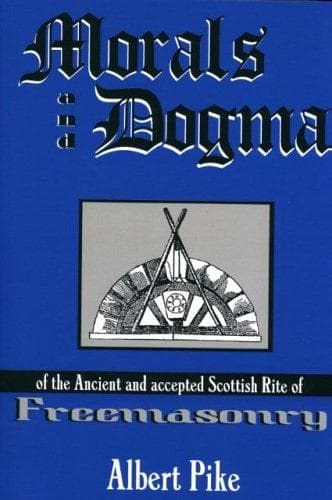
Morals and Dogma of the Ancient and Accepted Scottish Rite of FreemasonryPike, Albert
Religion
Morals and Dogma of the Ancient and Accepted Scottish Rite of Freemasonry
Pike, Albert
Freemasons
We do not further follow the Kabalah in its four Worlds of Spirits,
_Aziluth, Briah, Yezirah_, and _Asiah_, or of _emanation, creation,
formation_, and _fabrication_, one inferior to and one emerging from the
other, the superior always enveloping the inferior; its doctrine that,
in all that exists, there is nothing purely material; that all comes
from God, and in all He proceeds by irradiation; that everything
subsists by the Divine ray that penetrates creation; and all is united
by the Spirit of God, which is the life of life; so that all is God; the
Existences that inhabit the four worlds, inferior to each other in
proportion to their distance from the Great King of Light: the contest
between the good and evil Angels and Principles, to endure until the
Eternal Himself comes to end it and re-establish the primitive harmony;
the four distinct parts of the Soul of Man; and the migrations of impure
souls, until they are sufficiently purified to share with the Spirits of
Light the contemplation of the Supreme Being whose Splendor fills the
Universe.
The WORD was also found in the Phœnician Creed. As in all those of Asia,
a WORD of God, written in starry characters, by the planetary
Divinities, and communicated by the Demi-Gods, as a profound mystery, to
the higher classes of the human race, to be communicated by them to
mankind, created the world. The faith of the Phœnicians was an emanation
from that ancient worship of the Stars, which in the creed of Zoroaster
alone, is connected with a faith in one God. Light and Fire are the most
important agents in the Phoenician faith. There is a race of children of
the Light. They adored the Heaven with its Lights, deeming it the
Supreme God.
Everything emanates from a Single Principle, and a Primitive Love, which
is the Moving Power of All and governs all. Light, by its union with
Spirit, whereof it is but the vehicle or symbol, is the Life of
everything, and penetrates everything. It should therefore be respected
and honored everywhere; for everywhere it governs and controls.
The Chaldaic and Jerusalem Paraphrasts endeavored to render the phrase,
DEBAR-YAHOVAH דבר יהוה, the Word of God, a personalty, wherever they met
with it. The phrase, "And God created man," is, in the Jerusalem Targum,
"And the Word of IHUH created man."
So, in xxviii. Gen. 20,21, where Jacob says: "If God [יהיה אלהי IHIH
ALHIM] will be with me..." then shall IHUH be my ALHIM [Hebrew ]; UHIH
IHUH Li LALHIM; and this stone shall be God's House [[Hebrew].. IHIH
BITH ALHIM]: Onkelos paraphrases it, "If the word of IHUH will be my
help ... then the word of IHUH shall be my God".
So, in iii. Gen. 8, for "The Voice of the Lord God" [[Hebrew], IHUH
ALHIM], we have, "The Voice of the Word of IHUH."
In ix. Wisdom, 1, "O God of my Fathers and Lord of Mercy! who has made
all things with thy word.. [Greek: έν λόγου σου.]"
And in xviii. Wisdom, 15, "Thine Almighty Word [Greek: Λογος] leaped
down from Heaven."
Public-domain text, read in full here on John Shaqi.
Reviews
Reviews
No reviews yet
Be the first to share your thoughts on this work.
Elsewhere in the archive
Join the Discussion
Join the discussion
Sign in to leave a comment or review.
Sign InorCreate an account