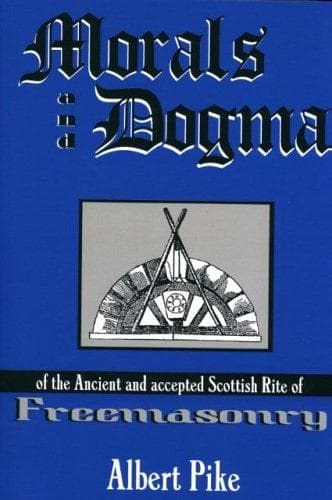
Morals and Dogma of the Ancient and Accepted Scottish Rite of FreemasonryPike, Albert
Religion
Morals and Dogma of the Ancient and Accepted Scottish Rite of Freemasonry
Pike, Albert
Freemasons
Philo speaks of the Word as being the same with God. So in several
places he calls it "[Greek: δεύτερος Θείος Λóγος]," the Second Divinity;
"[Greek: είμώντουΘεού]," the Image of God: the Divine Word that made all
things: "the [Greek: υπαρχος]," substitute, of God; and the like.
Thus, when John commenced to preach, had been for ages agitated, by the
Priests and Philosophers of the East and West, the great questions
concerning the eternity or creation of matter: immediate or intermediate
creation of the Universe by the Supreme God; the origin, object, and
filial extinction of evil; the relations between the intellectual and
material worlds, and between God and man; and the creation, fall,
redemption, and restoration to his first estate, of man.
The Jewish doctrine, differing in this from all the other Oriental
creeds, and even from the Alohayistic legend with which the book of
Genesis commences, attributed the creation to the immediate action of
the Supreme Being. The Theosophists of the other Eastern Peoples
interposed more than one intermediary between God and the world. To
place between them but a single Being, to suppose for the production of
the world but a single intermediary, was, in their eyes, to lower the
Supreme Majesty. The interval between God, who is perfect Purity, and
matter, which is base and foul, was too great for them to clear it at a
single step. Even in the Occident, neither Plato nor Philo could thus
impoverish the Intellectual World.
Thus, Cerinthus of Ephesus, with most of the Gnostics, Philo, the
Kabalah, the Zend-Avesta, the Puranas, and all the Orient, deemed the
distance and antipathy between the Supreme Being and the material world
too great, to attribute to the former the Creation of the latter. Below,
and emanating from, or created by, the Ancient of Days, the Central
Light, the Beginning, or First Principle [[Greek: Αρχή]], one, two, or
more Principles, Existences or Intellectual Beings were imagined, to
some one or more of whom [without any immediate creative act on the part
of the Great Immovable, Silent Deity], the immediate creation of the
material and mental universe was due.
Public-domain text, read in full here on John Shaqi.
Reviews
Reviews
No reviews yet
Be the first to share your thoughts on this work.
Elsewhere in the archive
Join the Discussion
Join the discussion
Sign in to leave a comment or review.
Sign InorCreate an account