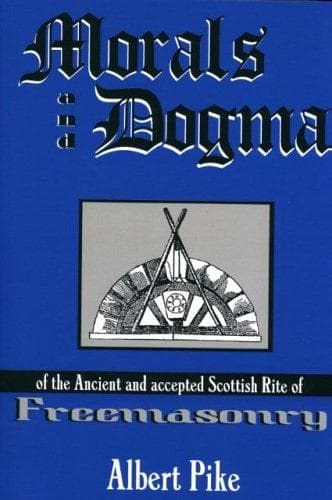
Morals and Dogma of the Ancient and Accepted Scottish Rite of Freemasonry — John Shaqi
Morals and Dogma of the Ancient and Accepted Scottish Rite of FreemasonryPike, Albert
Religion
Morals and Dogma of the Ancient and Accepted Scottish Rite of Freemasonry
Pike, Albert
Freemasons
Do not lose sight, then, of the true object of your studies in Masonry.
It is to add to your estate of wisdom, and not merely to your knowledge.
A man may spend a lifetime in studying a single specialty of
knowledge,--botany, conchology, or entomology, for instance,--in
committing to memory names derived from the Greek, and classifying and
reclassifying; and yet be no wiser than when he began. It is the great
truths as to all that most concerns a man, as to his rights, interests,
and duties, that Masonry seeks to teach her Initiates.
The wiser a man becomes, the less will he be inclined to submit tamely
to the imposition of fetters or a yoke, on his conscience or his person.
For, by increase of wisdom he not only better _knows_ his rights, but
the more highly _values_ them, and is more conscious of his worth and
dignity. His pride then urges him to assert his independence. He becomes
better _able_ to assert it also; and better able to assist others or his
country, when they or she stake all, even existence, upon the same
assertion. But mere knowledge makes no one independent, nor fits him to
be free. It often only makes him a more useful slave. Liberty is a curse
to the ignorant and brutal.
Political science has for its object to ascertain in what manner and by
means of what institutions political and personal freedom may be secured
and perpetuated: not license, or the mere right of every man to vote,
but entire and absolute freedom of thought and opinion, alike free of
the despotism of monarch and mob and prelate; freedom of action within
the limits of the general law enacted for all; the Courts of Justice,
with impartial Judges and juries, open to all alike; weakness and
poverty equally potent in those Courts as power and wealth; the avenues
to office and honor open alike to all the worthy; the military powers,
_in war or peace_, in strict subordination to the civil power; arbitrary
arrests for acts not known to the law as crimes, impossible; Romish
Inquisitions, Star-Chambers, Military Commissions, unknown; the means
of instruction within reach of the children of all; the right of Free
Speech; and accountability of all public officers, civil and military.
Public-domain text, read in full here on John Shaqi.
Reviews
Reviews
No reviews yet
Be the first to share your thoughts on this work.
Join the Discussion
Join the discussion
Sign in to leave a comment or review.
Sign InorCreate an account