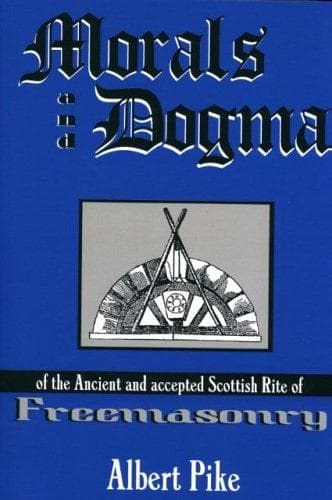
Morals and Dogma of the Ancient and Accepted Scottish Rite of FreemasonryPike, Albert
Religion
Morals and Dogma of the Ancient and Accepted Scottish Rite of Freemasonry
Pike, Albert
Freemasons
Each of us makes such applications to his own faith and creed, of the
symbols and ceremonies of this Degree, as seems to him proper. With
these special interpretations we have here nothing to do. Like the
legend of the Master Khūrūm, in which some see figured the condemnation
and sufferings of Christ; others those of the unfortunate Grand Master
of the Templars; others those of the first Charles, King of England; and
others still the annual descent of the Sun at the winter Solstice to the
regions of darkness, the basis of many an ancient legend; so the
ceremonies of this Degree receive different explanations; each
interpreting them for himself, and being offended at the interpretation
of no other.
In no other way could Masonry possess its character of Universality;
that character which has ever been peculiar to it from its origin; and
which enables two Kings, worshippers of different Deities, to sit
together as Masters, while the walls of the first temple arose; and the
men of Gebal, bowing down to the Phœnician Gods, to work by the side of
the Hebrews to whom those Gods were abomination; and to sit with them in
the same Lodge as brethren.
You have already learned that these ceremonies have one general
significance, to every one, of every faith, who believes in God, and the
soul's immortality.
The primitive men met in no Temples made with human hands. "God," said
Stephen, the first Martyr, "dwelleth not in Temples made with hands." In
the open air, under the overarching mysterious sky, in the great
World-Temple, they uttered their vows and thanksgivings, and adored the
God of Light; of that Light that was to them the type of Good, as
darkness was the type of Evil.
All antiquity solved the enigma of the existence of Evil, by supposing
the existence of a Principle of Evil, of Demons, fallen Angels, an
Ahriman, a Typhon, a Siva, a Lok, or a Satan, that, first falling
themselves, and plunged in misery and darkness, tempted man to his fall,
and brought sin into the world. All believed in a future life, to be
attained by purification and trials; in a state or successive states of
reward and punishment; and in a Mediator or Redeemer, by whom the Evil
Principle was to be overcome, and the Supreme Deity reconciled to His
creatures. The belief was general, that He was to be born of a Virgin,
and suffer a painful death. The Indians called him Chrishna; the
Chinese, Kioun-tse; the Persians, Sosiosch; the Chaldeans, Dhou-vanai;
the Egyptians, Har-Oeri; Plato, Love; and the Scandinavians, Balder.
Chrishna, the Hindoo Redeemer, was cradled and educated among Shepherds.
A Tyrant, at the time of his birth, ordered all the male children to be
slain. He performed miracles, say his legends, even raising the dead. He
washed the feet of the Brahmins, and was meek and lowly of spirit. He
was born of a Virgin; descended to Hell, rose again, ascended to Heaven,
charged his disciples to teach his doctrines, and gave them the gift of
miracles.
Public-domain text, read in full here on John Shaqi.
Reviews
Reviews
No reviews yet
Be the first to share your thoughts on this work.
Elsewhere in the archive
Join the Discussion
Join the discussion
Sign in to leave a comment or review.
Sign InorCreate an account