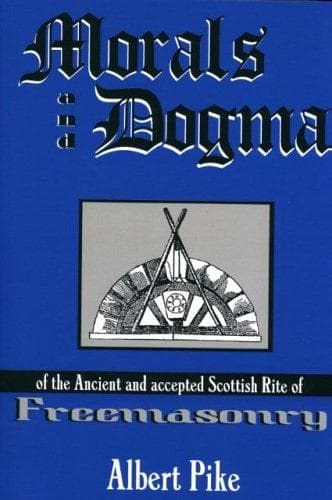
Morals and Dogma of the Ancient and Accepted Scottish Rite of FreemasonryPike, Albert
Religion
Morals and Dogma of the Ancient and Accepted Scottish Rite of Freemasonry
Pike, Albert
Freemasons
The first Masonic Legislator whose memory is preserved to us by history,
was Buddha, who, about a thousand years before the Christian era,
reformed the religion of Manous. He called to the Priesthood all men,
without distinction of caste, who felt themselves inspired by God to
instruct men. Those who so associated themselves formed a Society of
Prophets under the name of Samaneans. They recognized the existence of a
single uncreated God, in whose bosom everything grows, is developed and
transformed. The worship of this God reposed upon the obedience of all
the beings He created. His feasts were those of the Solstices. The
doctrines of Buddha pervaded India, China, and Japan. The Priests of
Brahma, professing a dark and bloody creed, brutalized by Superstition,
united together against Buddhism, and with the aid of Despotism,
exterminated its followers. But their blood fertilized the new doctrine,
which produced a new Society under the name of Gymnosophists; and a
large number, fleeing to Ireland, planted their doctrines there, and
there erected the round towers, some of which still stand, solid and
unshaken as at first visible monuments of the remotest ages.
The Phœnician Cosmogony, like all others in Asia, was the Word of God,
written in astral characters, by the planetary Divinities, and
communicated by the Demi-gods, as a profound mystery, to the brighter
intelligences of Humanity, to be propagated by them among men. Their
doctrines resembled the Ancient Sabeism, and being the faith of Hiram
the King and his namesake the Artist, are of interest to all Masons.
With them, the First Principle was half material, half spiritual, a dark
air, animated and impregnated by the spirit; and a disordered chaos,
covered with thick darkness. From this came the WORD, and thence
creation and generation; and thence a race of men, children of light,
who adored Heaven and its Stars as the Supreme Being; and whose
different gods were but incarnations of the Sun, the Moon, the Stars,
and the Ether. _Chrysor_ was the great igneous power of Nature, and
_Baal_ and _Malakarth_ representations of the Sun and Moon, the latter
word, in Hebrew, meaning Queen.
Man had fallen, but not by the tempting of the serpent. For, with the
Phœnicians, the serpent was deemed to partake of the Divine Nature, and
was sacred, as he was in Egypt. He was deemed to be immortal, unless
slain by violence, becoming young again in his old age, by entering into
and consuming himself. Hence the Serpent in a circle, holding his tail
in his mouth, was an emblem of eternity. With the head of a hawk he was
of a Divine Nature, and a symbol of the sun. Hence one Sect of the
Gnostics took him for their good genius, and hence the brazen serpent
reared by Moses in the Desert, on which the Israelites looked and lived.
Public-domain text, read in full here on John Shaqi.
Reviews
Reviews
No reviews yet
Be the first to share your thoughts on this work.
Elsewhere in the archive
Join the Discussion
Join the discussion
Sign in to leave a comment or review.
Sign InorCreate an account