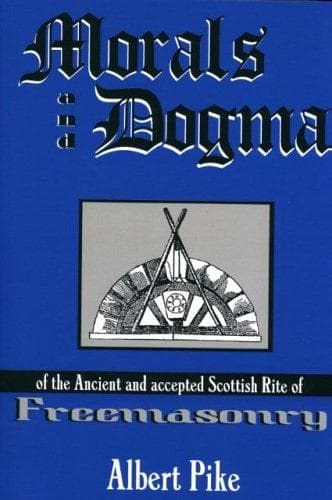
Morals and Dogma of the Ancient and Accepted Scottish Rite of FreemasonryPike, Albert
Religion
Morals and Dogma of the Ancient and Accepted Scottish Rite of Freemasonry
Pike, Albert
Freemasons
"Before the chaos, that preceded the birth of Heaven and Earth," said
the Chinese Lao-Tseu, "a single Being existed, immense and silent,
immutable and always acting; the mother of the Universe. I know not the
name of that Being, but I designate it by the word Reason. Man has his
model in the earth, the earth in Heaven, Heaven in Reason, and Reason in
itself."
"I am," says Isis, "Nature; parent of all things, the sovereign of the
Elements, the primitive progeny of Time, the most exalted of the
Deities, the first of the Heavenly Gods and Goddesses, the Queen of the
Shades, the uniform countenance; who dispose with my rod the numerous
lights of Heaven, the salubrious breezes of the sea, and the mournful
silence of the dead; whose single Divinity the whole world venerates in
many forms, with various rites and by many names. The Egyptians, skilled
in ancient lore, worship me with proper ceremonies, and call me by my
true name, Isis the Queen."
The Hindu Vedas thus define the Deity:
"He who surpasses speech, and through whose power speech is expressed,
know thou that He is Brahma; and not these perishable things that man
adores.
"He whom Intelligence cannot comprehend, and He alone, say the sages,
through whose Power the nature of Intelligence can be understood, know
thou that He is Brahma; and not these perishable things that man adores.
"He who cannot be seen by the organ of sight, and through whose power
the organ of seeing sees, know thou that He is Brahma; and not these
perishable things that man adores.
"He who cannot be heard by the organ of hearing, and through whose power
the organ of hearing hears, know thou that He is Brahma; and not these
perishable things that man adores.
"He who cannot be perceived by the organ of smelling, and through whose
power the organ of smelling smells, know thou that He is Brahma; and not
these perishable things that man adores."
"When God resolved to create the human race," said _Arius_, "He made a
Being that He called The WORD, The Son, _Wisdom_, to the end that this
Being might give existence to men." This WORD is the _Ormuzd_ of
Zoroaster, the _Ainsoph_ of the Kabalah, the [Greek: Νου̃ς] of Plato and
Philo, the _Wisdom_ or _Demiourgos_ of the Gnostics.
That is the True Word, the knowledge of which our ancient brethren
sought as the priceless reward of their labors on the Holy Temple: the
Word of Life, the Divine Reason, "in whom was Life, and that Life the
Light of men"; "which long shone in darkness, and the darkness
comprehended it not;" the Infinite Reason that is the Soul of Nature,
immortal, of which the Word of this Degree reminds us; and to believe
wherein and revere it, is the peculiar duty of every Mason.
Public-domain text, read in full here on John Shaqi.
Reviews
Reviews
No reviews yet
Be the first to share your thoughts on this work.
Elsewhere in the archive
Join the Discussion
Join the discussion
Sign in to leave a comment or review.
Sign InorCreate an account