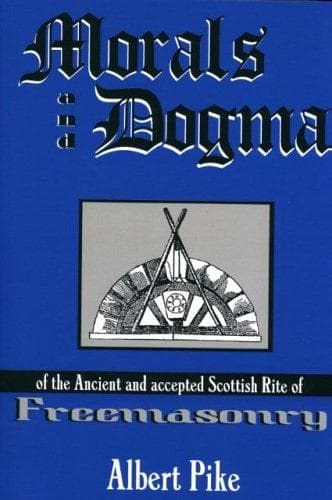
Morals and Dogma of the Ancient and Accepted Scottish Rite of FreemasonryPike, Albert
Religion
Morals and Dogma of the Ancient and Accepted Scottish Rite of Freemasonry
Pike, Albert
Freemasons
Aristotle says: "It has been handed down in a mythical form, from the
earliest times to posterity, that there are Gods, and that The Divine
compasses entire nature. All besides this has been added, after the
mythical style, for the purpose of persuading the multitude, and for the
interest of the laws and the advantage of the State. Thus men have given
to the Gods human forms, and have even represented them under the figure
of other beings, in the train of which fictions followed many more of
the same sort. But if, from all this, we separate the original
principle, and consider it alone, namely, that the first Essences are
Gods, we shall find that this has been divinely said; and since it is
probable that philosophy and the arts have been several times, so far as
that is possible, found and lost, such doctrines may have been preserved
to our times as the remains of ancient wisdom."
Porphyry says: "By images addressed to sense, the ancients represented
God and his powers--by the visible they typified the invisible for those
who had learned to read in these types, as in a book, a treatise on the
Gods. We need not wonder if the ignorant consider the images to be
nothing more than wood or stone; for just so, they who are ignorant of
writing see nothing in monuments but stone, nothing in tablets but wood,
and in books but a tissue of papyrus."
Apollonius of Tyana held, that birth and death are only in appearance;
that which separates itself from the _one_ substance (the _one_ Divine
essence), and is caught up by matter, seems to be born; that, again,
which releases itself from the bonds of matter, and is reunited with the
one Divine Essence, seems to die. There is, at most, an alteration
between becoming visible and becoming invisible. In all there is,
properly speaking, but the one essence, which alone acts and suffers, by
becoming all things to all; the Eternal God, whom men wrong, when they
deprive Him of what properly can be attributed to Him only, and transfer
it to other names and persons.
The New Platonists substituted the idea of the Absolute, for the Supreme
Essence itself;--as the first, simplest principle, anterior to all
existence; of which nothing determinate can be predicated; to which no
consciousness, no self-contemplation can be ascribed; inasmuch as to do
so, would immediately imply a quality, a distinction of subject and
object. This Supreme Entity can be known only by an intellectual
intuition of the Spirit, transcending itself, and emancipating itself
from its own limits.
Public-domain text, read in full here on John Shaqi.
Reviews
Reviews
No reviews yet
Be the first to share your thoughts on this work.
Elsewhere in the archive
Join the Discussion
Join the discussion
Sign in to leave a comment or review.
Sign InorCreate an account