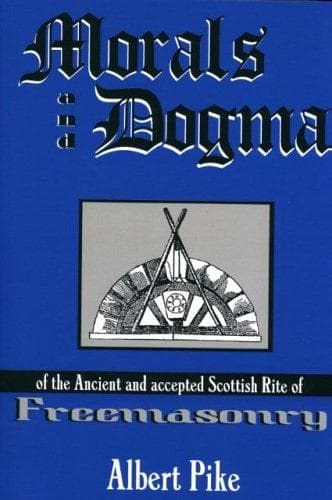
Morals and Dogma of the Ancient and Accepted Scottish Rite of FreemasonryPike, Albert
Religion
Morals and Dogma of the Ancient and Accepted Scottish Rite of Freemasonry
Pike, Albert
Freemasons
This mere logical tendency, by means of which men thought to arrive at
the conception of such an absolute, the [Greek: όν], was united with a
certain mysticism, which, by a transcendent state of feeling,
communicated, as it were, to this abstraction what the mind would
receive as a reality. The absorption of the Spirit into that
superexistence ([Greek: τό έπέκεινα τής ούσίας]), so as to be entirely
identified with it, or such a revelation of the latter to the spirit
raised above itself, was regarded as the highest end which the spiritual
life could reach.
The New Platonists' idea of God, was that of One Simple Original
Essence, exalted above all plurality and all becoming; the only true
Being; unchangeable, eternal [[Greek: Εϊς ών ένί τώ νύν τό άει πεπλήρωκε
καί μόνον έστι τό κατά τούτον όντως ών]]: from whom all Existence in its
several gradations has emanated--the world of Gods, as nearest akin to
Himself, being first, and at the head of all. In these Gods, that
perfection, which in the Supreme Essence was inclosed and unevolved, is
expanded and becomes knowable. They serve to exhibit in different forms
the image of that Supreme Essence, to which no soul can rise, except by
the loftiest flight of contemplation; and after it has rid itself from
all that pertains to sense--from all manifoldness. They are the
mediators between man (amazed and stupefied by manifoldness) and the
Supreme Unity.
Philo says: "He who disbelieves the miraculous, simply as the
miraculous, neither knows God, nor has he ever sought after Him; for
otherwise he would have understood, by looking at that truly great and
awe-inspiring sight, the miracle of the Universe, that these miracles
(in God's providential guidance of His people) are but child's play for
the Divine Power. But the truly miraculous has become despised through
familiarity. The universal, on the contrary, although in itself
insignificant, yet, through our love of novelty, transports us with
amazement."
In opposition to the anthropopathism of the Jewish Scriptures, the
Alexandrian Jews endeavored to purify the idea of God from all admixture
of the Human. By the exclusion of every human passion, it was sublimated
to a something devoid of all attributes, and wholly transcendental; and
the mere Being [Greek: όν], the Good, in and by itself, the Absolute of
Platonism, was substituted for the personal Deity [[Hebrew: יהוה]] of
the Old Testament. By soaring upward, beyond all created existence, the
mind, disengaging itself from the Sensible, attains to the intellectual
intuition of this Absolute Being; of whom, however, it can predicate
nothing but existence, and sets aside all other determinations as not
answering to the exalted nature of the Supreme Essence.
Public-domain text, read in full here on John Shaqi.
Reviews
Reviews
No reviews yet
Be the first to share your thoughts on this work.
Elsewhere in the archive
Join the Discussion
Join the discussion
Sign in to leave a comment or review.
Sign InorCreate an account