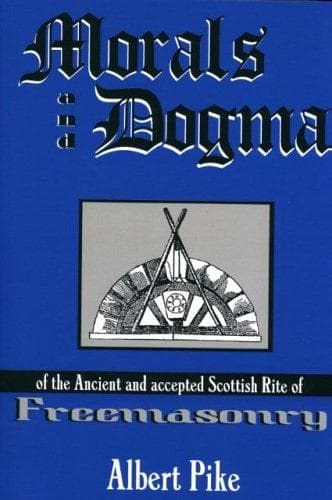
Morals and Dogma of the Ancient and Accepted Scottish Rite of FreemasonryPike, Albert
Religion
Morals and Dogma of the Ancient and Accepted Scottish Rite of Freemasonry
Pike, Albert
Freemasons
The foundations of our faith, resting upon the imagined interest of God
in our race, an interest easily supposable when man believed himself the
only intelligent created being, and therefore eminently worthy the
especial care and watchful anxiety of a God who had only this earth to
look after, and its house-keeping alone to superintend, and who was
content to create, in all the infinite Universe, only one single being,
possessing a soul, and not a mere animal, are rudely shaken as the
Universe broadens and expands for us; and the darkness of doubt and
distrust settles heavy upon the Soul.
The modes in which it is ordinarily endeavored to satisfy our doubts,
only increase them. To _demonstrate_ the necessity for a cause of the
creation, is equally to demonstrate the necessity of a cause for that
cause. The argument from plan and design only removes the difficulty a
step further off. We rest the world on the elephant, and the elephant on
the tortoise, and the tortoise on--nothing.
To tell us that the animals possess instinct only and that Reason
belongs to us alone, in no way tends to satisfy us of the radical
difference between us and them. For if the mental phenomena exhibited
by animals that think, dream, remember, argue from cause to effect,
plan, devise, combine, and communicate their thoughts to each other, so
as to act rationally in concert,--if their love, hate, and revenge, can
be conceived of as results of the organization of matter, like color and
perfume, the resort to the hypothesis of an immaterial Soul to explain
phenomena of the same kind, only more perfect, manifested by the _human_
being, is supremely absurd. That organized matter can think or even
_feel_ at all, is the great insoluble mystery. "Instinct" is but a word
without a meaning, or else it means inspiration. It is either the animal
itself, or God _in_ the animal, that thinks, remembers, and reasons; and
instinct, according to the common acceptation of the term, would be the
greatest and most wonderful of mysteries,--no less a thing than the
direct, immediate, and continual promptings of the Deity,--for the
animals are not machines, or automata moved by springs, and the ape is
but a dumb Australian.
Must we _always_ remain in this darkness of uncertainty, of doubt? Is
there _no_ mode of escaping from the labyrinth except by means of a
blind faith, which explains nothing, and in many creeds, ancient and
modern, sets Reason at defiance, and leads to the belief either in a God
without a Universe, a Universe without a God, or a Universe which is
itself a God?
Public-domain text, read in full here on John Shaqi.
Reviews
Reviews
No reviews yet
Be the first to share your thoughts on this work.
Elsewhere in the archive
Join the Discussion
Join the discussion
Sign in to leave a comment or review.
Sign InorCreate an account