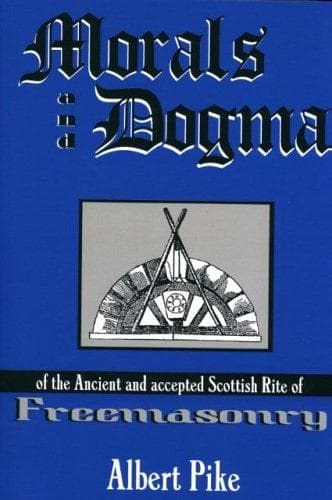
Morals and Dogma of the Ancient and Accepted Scottish Rite of FreemasonryPike, Albert
Religion
Morals and Dogma of the Ancient and Accepted Scottish Rite of Freemasonry
Pike, Albert
Freemasons
We believe that the soul of another is of a certain nature and possesses
certain qualities, that he is generous and honest, or penurious and
knavish, that she is virtuous and amiable, or vicious and ill-tempered,
from the countenance alone, from little more than a glimpse of it,
without the means of _knowing_. We venture our fortune on the signature
of a man on the other side of the world, whom we never saw, upon the
belief that he is honest and trustworthy. We believe that occurrences
have taken place, upon the assertion of others. We believe that one will
acts upon another, and in the reality of a multitude of other phenomena
that Reason cannot explain.
But we ought _not_ to believe what Reason authoritatively denies, that
at which the sense of right revolts, that which is absurd or
self-contradictory, or at issue with experience or science, or that
which degrades the character of the Deity, and would make Him
revengeful, malignant, cruel, or unjust.
A man's Faith is as much his own as his Reason is. His Freedom consists
as much in his faith being free as in his will being uncontrolled by
power. All the Priests and Augurs of Rome or Greece had not the right to
require Cicero or Socrates to believe in the absurd mythology of the
vulgar. All the Imaums of Mohammedanism have not the right to require a
Pagan to believe that Gabriel dictated the Koran to the Prophet. All the
Brahmins that ever lived, if assembled in one conclave like the
Cardinals, could not gain a right to compel a single human being to
believe in the Hindu Cosmogony. No man or body of men _can_ be
infallible, and authorized to decide what other men shall believe, as to
any tenet of faith. Except to those who first receive it, every religion
and the truth of all inspired writings depend on _human_ testimony and
internal evidences, to be judged of by Reason and the wise analogies of
Faith. Each man must necessarily have the right to judge of their truth
for himself; because no one man can have any higher or better right to
judge than another of equal information and intelligence.
Domitian claimed to be the Lord God; and statues and images of him, in
silver and gold, were found throughout the known world. He claimed to be
regarded as the God of all men; and, according to Suetonius, began his
letters thus: "_Our Lord and God commands that it should be done so and
so_;" and formally decreed that no one should address him otherwise,
either in writing or by word of mouth. Palfurius Sura, the philosopher,
who was his chief delator, accusing those who refused to recognize his
divinity, however much _he_ may have believed in that divinity, had not
the right to demand that a single Christian in Rome or the provinces
should do the same.
Public-domain text, read in full here on John Shaqi.
Reviews
Reviews
No reviews yet
Be the first to share your thoughts on this work.
Join the Discussion
Join the discussion
Sign in to leave a comment or review.
Sign InorCreate an account