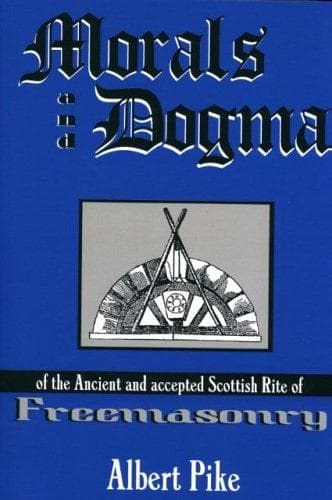
Morals and Dogma of the Ancient and Accepted Scottish Rite of FreemasonryPike, Albert
Religion
Morals and Dogma of the Ancient and Accepted Scottish Rite of Freemasonry
Pike, Albert
Freemasons
Miltiades was fortunate that he was exiled; and Aristides that he was
ostracized, because men wearied of hearing him called "The Just." Not
the Redeemer was unfortunate; but those only who repaid Him for the
inestimable gift He offered them, and for a life passed in toiling for
their good, by nailing Him upon the cross, as though He had been a slave
or malefactor. The persecutor dies and rots, and Posterity utters his
name with execration, but his victim's memory he has unintentionally
made glorious and immortal.
If not for slander and persecution, the Mason who would benefit his
race must look for apathy and cold indifference in those whose good he
seeks, in those who ought to seek the good of others. Except when the
sluggish depths of the Human Mind are broken up and tossed as with a
storm, when at the appointed time a great Reformer comes, and a new
Faith springs up and grows with supernatural energy, the progress of
Truth is slower than the growth of oaks; and he who plants need not
expect to gather. The Redeemer, at His death, had twelve disciples, and
one betrayed and one deserted and denied Him. It is enough for us to
know that the fruit will come in its due season. When, or who shall
gather it, it does not in the least concern us to know. It is our
business to plant the seed. It is God's right to give the fruit to whom
He pleases; and if not to us, then is our action by so much the more
noble.
To sow, that others may reap; to work and plant for those who are to
occupy the earth when we are dead; to project our influences far into
the future, and live beyond our time; to rule as the Kings of Thought,
over men who are yet unborn; to bless with the glorious gifts of Truth
and Light and Liberty those who will neither know the name of the giver,
nor care in what grave his unregarded ashes repose, is the true office
of a Mason and the proudest destiny of a man.
All the great and beneficent operations of Nature are produced by slow
and often imperceptible degrees. The work of destruction and devastation
only is violent and rapid. The Volcano and the Earthquake, the Tornado
and the Avalanche, leap suddenly into full life and fearful energy, and
smite with an unexpected blow. Vesuvius buried Pompeii and Herculaneum
in a night; and Lisbon fell prostrate before God in a breath, when the
earth rocked and shuddered; the Alpine village vanishes and is erased at
one bound of the avalanche; and the ancient forests fall like grass
before the mower, when the tornado leaps upon them. Pestilence slays its
thousands in a day; and the storm in a night strews the sand with
shattered navies.
Public-domain text, read in full here on John Shaqi.
Reviews
Reviews
No reviews yet
Be the first to share your thoughts on this work.
Elsewhere in the archive
Join the Discussion
Join the discussion
Sign in to leave a comment or review.
Sign InorCreate an account