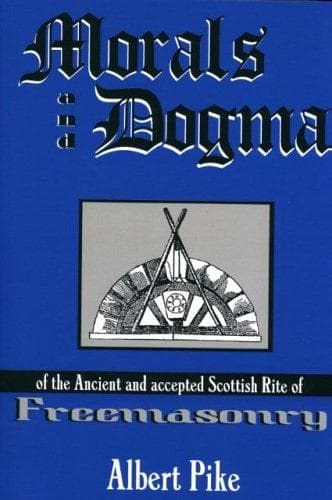
Morals and Dogma of the Ancient and Accepted Scottish Rite of FreemasonryPike, Albert
Religion
Morals and Dogma of the Ancient and Accepted Scottish Rite of Freemasonry
Pike, Albert
Freemasons
In every _credo_, religious or political as in the soul of man, there
are two regions, the Dialectic and the Ethic; and it is only when the
two are harmoniously blended, that a perfect discipline is evolved.
There are men who dialectically are Christians, as there are a multitude
who dialectically are Masons, and yet who are ethically Infidels, as
these are ethically of the Profane, in the strictest
sense:--intellectual believers, but practical atheists--men who will
write you "Evidences," in perfect faith in their logic, but cannot carry
out the Christian or Masonic doctrine, owing to the strength, or
weakness, of the flesh. On the other hand, there are many dialectical
skeptics, but ethical believers, as there are many Masons who have never
undergone initiation; and as ethics are the end and purpose of religion,
so are ethical believers the most worthy. He who _does_ right is better
than he who _thinks_ right.
But you must not act upon the hypothesis that all men are hypocrites,
whose conduct does not square with their sentiments. No vice is more
rare, for no task is more difficult, than systematic hypocrisy. When the
Demagogue becomes a Usurper it does not follow that he was all the time
a hypocrite. Shallow men only so judge of others.
The truth is, that creed has, in general, very little influence on the
conduct; in religion, on that of the individual; in politics, on that of
party. As a general thing, the Mahometan, in the Orient, is far more
honest and trustworthy than the Christian. A Gospel of Love in the
mouth, is an Avatar of Persecution in the heart. Men who believe in
eternal damnation and a literal sea of fire and brimstone, incur the
certainty of it, according to their creed, on the slightest temptation
of appetite or passion. Predestination insists on the necessity of good
works. In Masonry, at the least now of passion, one speaks ill of
another behind his back; and so far from the "Brotherhood" of Blue
Masonry being real, and the solemn pledges contained in the use of the
word "Brother" being complied with, extraordinary pains are taken to
show that Masonry is a sort of abstraction, which scorns to interfere in
worldly matters. The rule may be regarded as universal, that, where
there is a choice to be made, a Mason will give his vote and influence,
in politics and business, to the less qualified profane in preference to
the better qualified Mason. One will take an oath to oppose any unlawful
usurpation of power, and then become the ready and even eager instrument
of a usurper. Another will call one "Brother," and then play toward him
the part of Judas Iscariot, or strike him, as Joab did Abner, under the
fifth rib, with a lie whose authorship is not to be traced. Masonry does
not change human nature, and cannot make honest men out of born knaves.
Public-domain text, read in full here on John Shaqi.
Reviews
Reviews
No reviews yet
Be the first to share your thoughts on this work.
Join the Discussion
Join the discussion
Sign in to leave a comment or review.
Sign InorCreate an account