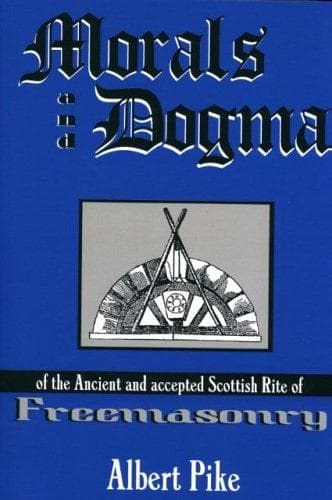
Morals and Dogma of the Ancient and Accepted Scottish Rite of FreemasonryPike, Albert
Religion
Morals and Dogma of the Ancient and Accepted Scottish Rite of Freemasonry
Pike, Albert
Freemasons
HORUS was the _mediator_, who was buried three days, was regenerated,
and triumphed over the evil principle.
The word HERI, in Sanscrit, means _Shepherd_, as well as _Saviour_.
CRISHNA is called _Heri_, as JESUS called Himself the _Good Shepherd_.
[Hebrew: הור], _Khūr_, means an aperture of a window, a cave, or the
eye. Also it means white. In Syriac, [Symbols].
[Hebrew: הר] also means an opening, and noble, free-born, high-born.
[Hebrew: הרם], KHURM means consecrated, devoted; in Æthiopic [Symbols]
It is the name of a city, [_Josh_. xix. 38]; and of a man, [_Ezr_. ii.
32, x. 31; _Neh_. iii. 11].
[Hebrew: היהה], _Khirah_, means nobility, a noble race.
Buddha is declared to comprehend in his own person the essence of the
Hindu Trimurti; and hence the tri-literal monosyllable _Om_ or _Aum_ is
applied to him as being essentially the same as Brahma-Vishnu-Siva. He
is the same as Hermes, Thoth, Taut, and Teutates. One of his names is
Heri-maya or Her-maya, which are evidently the same name as Hermes and
Khirm or Khūrm. Heri, in Sanscrit, means _Lord_.
A learned Brother places over the two symbolic pillars, from right to
left, the two words [Symbols] and [Symbols] [Hebrew: יהו] and [Hebrew:
בעל], IHU and BAL: followed by the hieroglyphic equivalent,
[Hieroglyphic: ] of the Sun-God, Amun-ra. Is it an accidental
coincidence, that in the name of each murderer are the two names of the
Good and Evil Deities of the Hebrews; for _Yu-bel_ is but _Yehu-Bal_ or
_Yeho-Bal?_ and that the three final syllables of the names, _a, o, um_,
make A.U.M. the sacred word of the Hindoos, meaning the Triune-God,
Life-giving, Life-preserving, Life-destroying: represented by the mystic
character [Mystic Character: Y].
The genuine _Acacia_, also, is the thorny tamarisk, the same tree which
grew up around the body of Osiris. It was a sacred tree among the Arabs,
who made of it the idol Al-Uzza, which Mohammed destroyed. It is
abundant as a bush in the Desert of Thur: and of it the "crown of
thorns" was composed, which was set on the forehead of Jesus of
Nazareth. It is a fit type of immortality on account of its tenacity of
life; for it has been known, when planted as a door-post, to take root
again and shoot out budding boughs over the threshold.
* * * * *
Public-domain text, read in full here on John Shaqi.
Reviews
Reviews
No reviews yet
Be the first to share your thoughts on this work.
Elsewhere in the archive
Join the Discussion
Join the discussion
Sign in to leave a comment or review.
Sign InorCreate an account