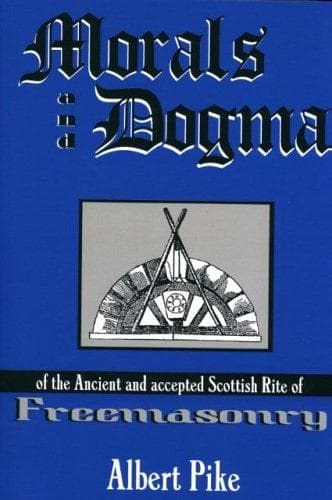
Morals and Dogma of the Ancient and Accepted Scottish Rite of FreemasonryPike, Albert
Religion
Morals and Dogma of the Ancient and Accepted Scottish Rite of Freemasonry
Pike, Albert
Freemasons
Who can estimate the value of morality and manliness in a State, of
moral worth and intellectual knowledge? These are the sunshine and rain
of the State. The winds, with their changeable, fickle, fluctuating
currents, are apt emblems of the fickle humors of the populace, its
passions, its heroic impulses, its enthusiasms. Woe to the statesman who
does not estimate these as values!
Even music and song are sometimes found to have an incalculable value.
Every nation has some song of a proven value, more easily counted in
lives than dollars. The Marseillaise was worth to revolutionary France,
who shall say how many thousand men?
Peace also is a great element of prosperity and wealth; a value not to
be calculated. Social intercourse and association of men in beneficent
Orders have a value not to be estimated in coin. The illustrious
examples of the Past of a nation, the memories and immortal thoughts of
her great and wise thinkers, statesmen, and heroes, are the invaluable
legacy of that Past to the Present and Future. And all these have not
only the values of the loftier and more excellent and priceless kind,
but also an actual _money_-value, since it is only when co-operating
with or aided or enabled by these, that human labor creates wealth. They
are of the chief elements of material wealth, as they are of national
manliness, heroism, glory, prosperity, and immortal renown.
* * * * *
Providence has appointed the three great disciplines of _War_, the
_Monarchy_ and the _Priesthood_, all that the CAMP, the PALACE, and the
TEMPLE may symbolize, to train the multitudes forward to intelligent and
premeditated combinations for all the great purposes of society. The
result will at length be free governments among men, when virtue and
intelligence become qualities of the multitudes; but for ignorance such
governments are impossible. Man advances only by degrees. The removal of
one pressing calamity gives courage to attempt the removal of the
remaining evils, rendering men more sensitive to them, or perhaps
sensitive for the first time. Serfs that writhe under the whip are not
disquieted about their political rights; manumitted from personal
slavery, they become sensitive to political oppression. Liberated from
arbitrary power, and governed by the law alone, they begin to scrutinize
the law itself, and desire to be governed, not only by law, but by what
they deem the best law. And when the civil or temporal despotism has
been set aside, and the municipal law has been moulded on the principles
of an enlightened jurisprudence, they may wake to the discovery that
they are living under some priestly or ecclesiastical despotism, and
become desirous of working a reformation there also.
Public-domain text, read in full here on John Shaqi.
Reviews
Reviews
No reviews yet
Be the first to share your thoughts on this work.
Elsewhere in the archive
Join the Discussion
Join the discussion
Sign in to leave a comment or review.
Sign InorCreate an account